|
All dentists talk while they work. They have inherited this from their
professional ancestors, the barbers. Most cursed of all are the dentists who made too many parenthetical
remarks -- dentists who secure your instant and breathless interest
in a tooth by taking a grip on it, and then stand there and drawl through
a tedious anecdote before they give the dreaded jerk. Parentheses in
literature and dentistry are in bad taste. |
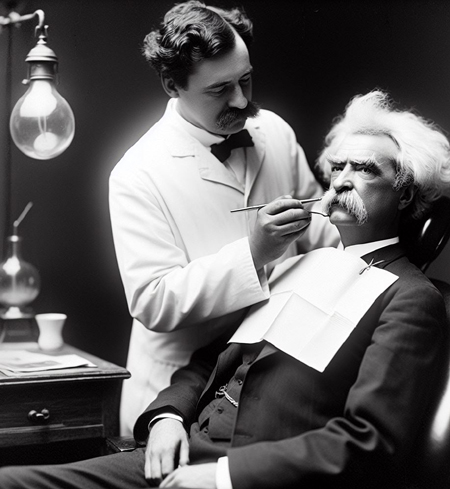 AI image created by R. Kent Rasmussen |
|
When teeth became touched with decay or were otherwise
ailing, the doctor knew of but one thing to do -- he fetched his tongs
and dragged them out. If the jaw remained, it was not his fault. Regarding
his personal dentist Dr. John M. Riggs: |
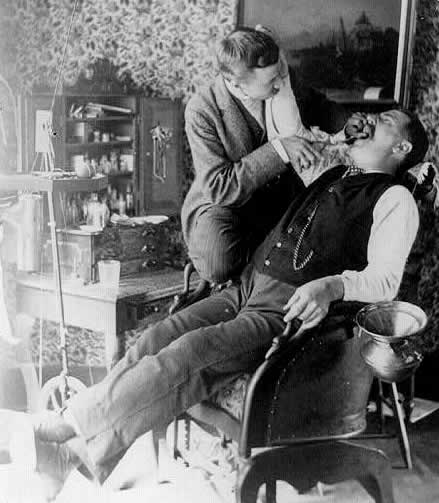 Photo from Library of Congress Prints and Photographs Division |
|
Then he put his tool into my mouth, rooted it up under a gum and began
to carve. He seemed to fetch away chips of bone the size of my hand. In
truth, what he removed could hardly have been seen without a microscope,
I suppose -- but my imagination is a microscope. If I had been honest
enough to speak my mind, I would have said "Ow!" to every dig,
and shouted it; but I was ashamed to do that, and so only said "um,"
in a low voice, and kept back the exclamation point. ... At the end of
an hour, something was said about chloroform. I knew I did not need it
myself, but I believed my imagination did. ... I could not touch anything
to my teeth for several days, they were so supernaturally sensitive. But
after that they became as tough as iron, and a thorough comfort. If by
some blessed accident my conscience could catch the Riggs disease, I know
what I would do with it. See also Pain vs Pleasure _____
|

Quotations | Newspaper Articles | Special Features | Links | Search