| This is the simple soldier, who, all untaught
of the silken phrase-makers, linked words together with an art surpassing
the art of the schools and put into them a something which will still bring
to American ears, as long as America shall last, the roll of his vanished
drums and the tread of his marching hosts. - Notebook, 1866 I can't rise to General Grant's lofty place in the estimation of this
nation, but it is a deep happiness to me to know that when it comes to
epistolary literature, he can't sit in the front seat along with me. I did not admire him so much for winning the war as for ending the war. |
|
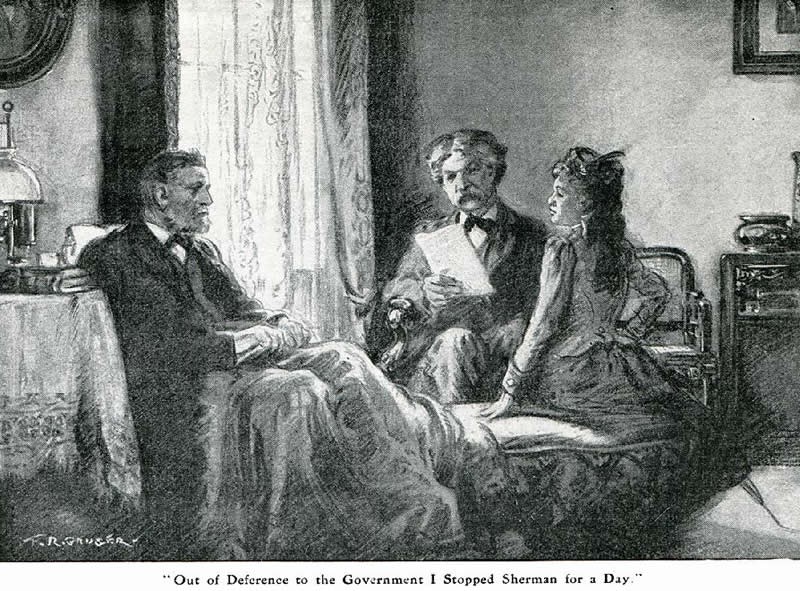
Illustration by Frederick Gruger from SUNDAY MAGAZINE, Dec. 1, 1907.
Ulysses Grant, Samuel Clemens and Susy Clemens
from the Dave Thomson collection.
|
There is that about the sun which makes us forget his spots;
and when we think of General Grant our pulses quicken and his grammar
vanishes; we only remember that this is the simple soldier, who, all untaught
of the silken phrase makers, linked words together with an art surpassing
the art of the schools, and put into them a something which will still
bring to American ears, as long as America shall last, the roll of his
vanished drums and the tread of the marching hosts. What do we care for
grammar when we think of the man that put together that thunderous phrase:
"Unconditional and immediate surrender!" And those others: "I
propose to move immediately upon your works!" "I propose to
fight it out on this line if it takes all summer!" Mr. Arnold would
doubtless claim that that last sentence is not strictly grammatical; and
yet it did certainly wake up this nation as a hundred million tons of
A No. 1, fourth-proof, hardboiled hidebound grammar from another mouth
couldn't have done. And finally we have that gentler phrase; that one
which shows you another true side of the man; shows that in his soldier
heart there was room for other than gory war mottoes, and in his tongue
the gift to fitly phrase them--"Let us have peace." But as long as American civilization lasts New York will
last. I cannot but think she has been well and wisely chosen as the guardian
of a grave which is destined to become almost the most conspicuous in
the world's history. Twenty centuries from now New York will still be
New York, still a vast city, and the most notable object in it will still
be the tomb and monument of General Grant. I observe that the common and
strongest objection to New York is that she is not "national ground."
Let us give ourselves no uneasiness about that. Wherever General Grant's
body lies, that is national ground. I think the most interesting personality I ever encountered
was General Grant. How and where he was so much larger than other men
I had ever met I cannot describe. It was the same sort of feeling, I suppose
that made my friend, Thomas Starr King, whilst listening to a celebrated
preacher, turn to me and exclaim, 'Whereabouts in that figure does that
imperial power reside.' You had that feeling with Grant exactly. The greatest man I have ever had the privilege of knowing
personally. And I have not known a man with a kinder nature or a purer
character. He was called the Silent Man -- the Sphynx -- and he was that,
in public, but not in private. There he was a fluent and able talker --
with a large sense of humor, and a most rare gift of compacting meaty
things into phrases of stunning felicity. |

Quotations | Newspaper Articles | Special Features | Links | Search