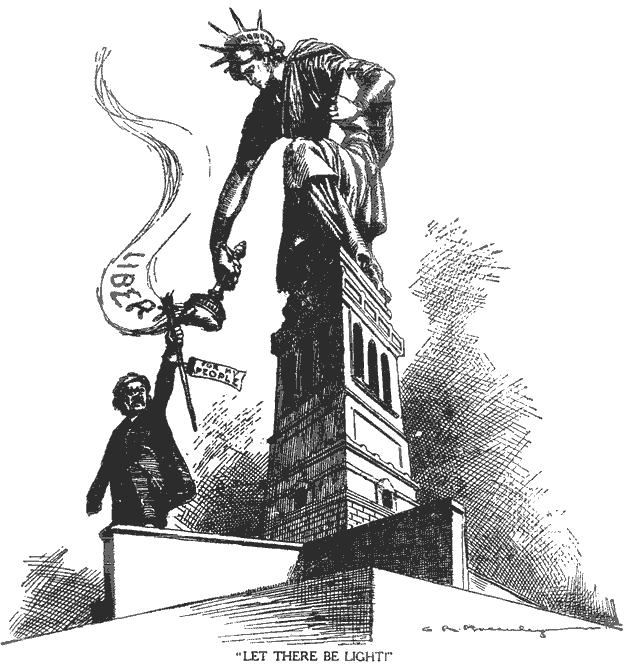
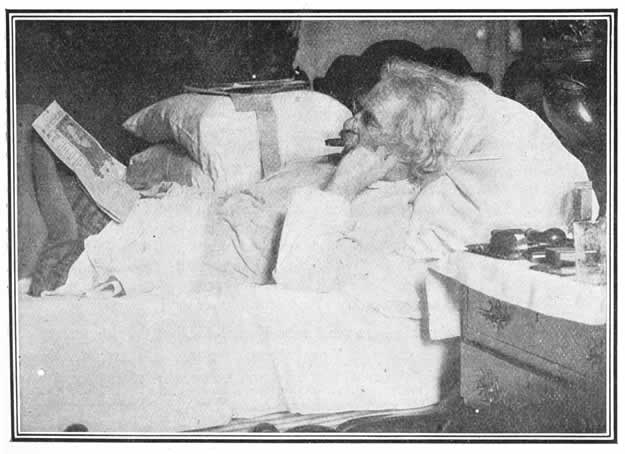
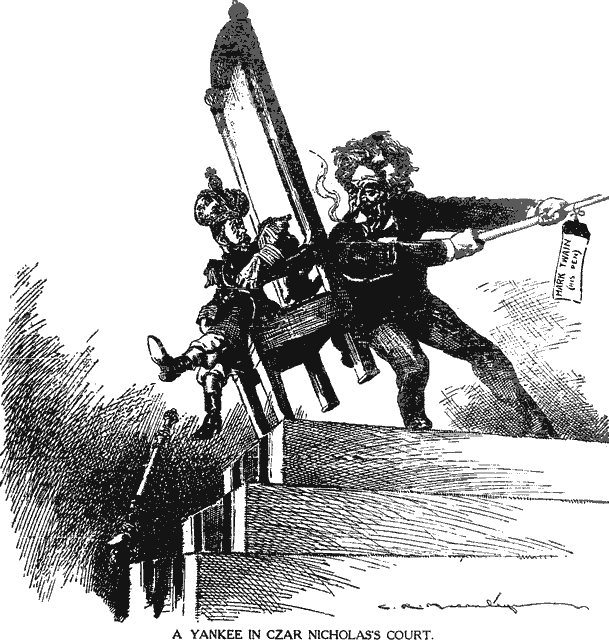
[The spelling of many Russian names varies in American sources because the Russian alphabet does not transliterate directly into the English alphabet. Spellings of Russian names are often translated using phonetic sounds rather than equivalent letters which accounts for variant spellings in different quoted sources throughout this article.]
MARK TWAIN VISITS RUSSIA, 1867
Mark Twain's first encounter with the ruling Romanov family of Russia was in August 1867 when he met Czar Alexander II in Yalta, during the Quaker City excursion to Europe and the Holy Land. The owners of the ship Quaker City were hoping to interest Czar Alexander II in buying the ship and a visit with him was included in the tour's itinerary.
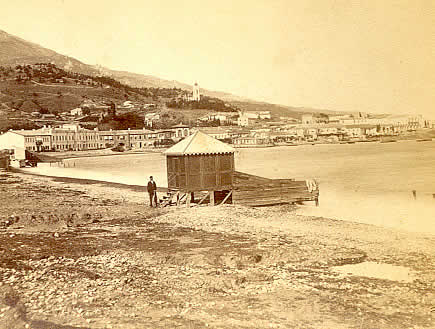 Yalta, on the shore of the Black Sea, located about 30 miles east of Sevastopol as the bird flies. On the hillside nearby was the summer residence of the Czar of Russia. From a stereocard by William E. James, photographer for the Quaker City excursion. |
Russia, an American ally, had supported the Union efforts during the recent American Civil War. Supporters of the Czar compared him with President Abraham Lincoln. In 1861 Czar Alexander II had issued an Emancipation Manifesto that abolished Russian serfdom -- an economic system built around peasant farm labor. Russian serfs were tied to the land on which they lived and, in effect, were human property of wealthy noblemen. Although serfs or peasants could not be sold, the land they were tied to could be sold. Estates were described as containing so many "souls" and when land was sold, it was valued at so much per "soul." It was an economic system that shared characteristics with the forced labor of black slaves in the United States. Czar Alexander II's Emancipation Manifesto was equated with Abraham Lincoln's Emancipation Proclamation of 1862 which expressed the principal that the United States government was finally taking a stand against slavery.
Mark Twain was selected by his fellow travelers to help write a speech addressing Alexander II. The speech was delivered by the American consul to Russia.
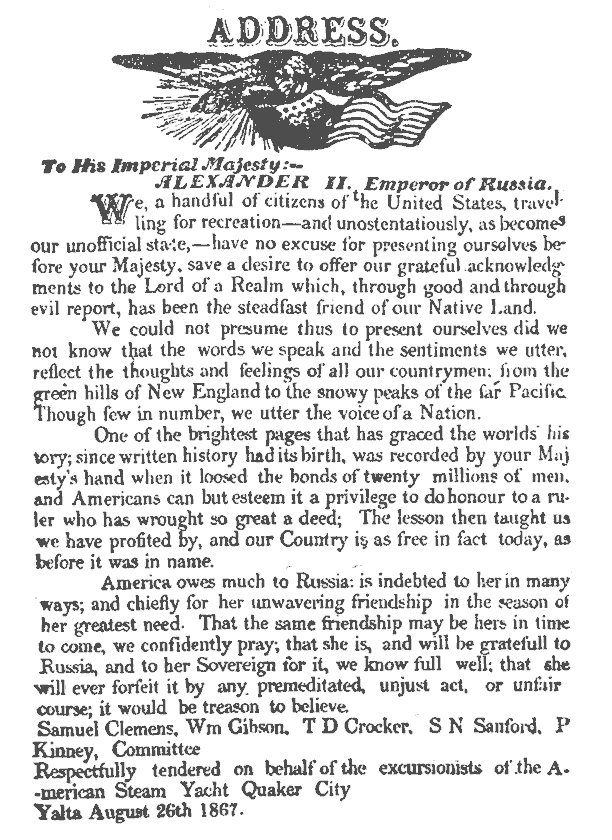 The speech written by Mark Twain was signed "Samuel Clemens." Included in his address to the Czar was the passage, "One of the brightest pages that has graced the world's history, since written history had its birth, was recorded by your Majesty's hand when it loosed the bonds of twenty millions of men, and Americans can but esteem it a privilege to do honour to a ruler who has wrought so great a deed." From Mark Twain: A Biography by Albert Bigelow Paine, p. 333. |
In describing this meeting in Innocents Abroad, Mark Twain wrote:
Taking the kind expression that is in the Emperor's face and the gentleness that is in his young daughter's into consideration, I wondered if it would not tax the Czar's firmness to the utmost to condemn a supplicating wretch to misery in the wastes of Siberia if she pleaded for him. … It seemed strange -- stranger than I can tell -- to think that the central figure in the cluster of men and women, chatting here under the trees like the most ordinary individual in the land, was a man who could open his lips and ships would fly through the waves, locomotives would speed over the plains, couriers would hurry from village to village, a hundred telegraphs would flash the word to the four corners of an Empire that stretches its vast proportions over a seventh part of the habitable globe, and a countless multitude of men would spring to do his bidding. I had a sort of vague desire to examine his hands and see if they were of flesh and blood, like other men's. Here was a man who could do this wonderful thing, and yet if I chose I could knock him down. The case was plain, but it seemed preposterous, nevertheless -- as preposterous as trying to knock down a mountain or wipe out a continent. If this man sprained his ankle, a million miles of telegraph would carry the news over mountains -- valleys -- uninhabited deserts -- under the trackless sea -- and ten thousand newspapers would prate of it; if he were grievously ill, all the nations would know it before the sun rose again; if he dropped lifeless where he stood, his fall might shake the thrones of half a world! If I could have stolen his coat, I would have done it. When I meet a man like that, I want something to remember him by (1).
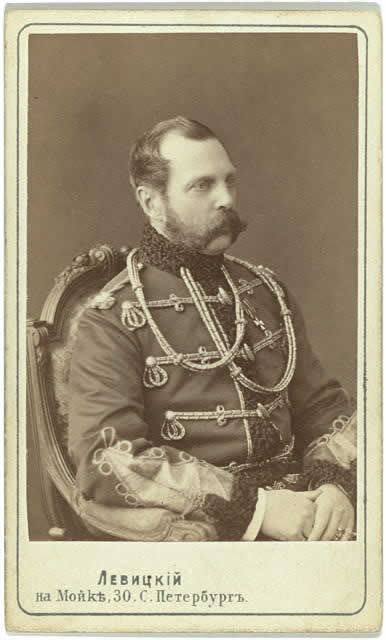
Czar Alexander II (1818-1881)
Mark Twain met Czar Alexander II in Yalta in August 1867.
Photo from Library of Congress Prints and Photographs Division._____
"O'SHAH," 1873
Samuel Clemens's high regard for the Russian aristocracy was firmly intact in the summer of 1873 when he accepted an assignment from the New York Herald newspaper to cover the visit of the Shah of Persia, Nasr-ed-Din, to London. (Some sources translate the Shah's name as Nasser al-Din). He wrote a series of five letters for the Herald in June of 1873 reporting the visit of the Shah, the first Persian ruler to visit Europe. Other royalty present at the London reception for the Shah of Persia was Czar Alexander II's son and future ruler of Russia, Alexander III. Twain described seeing the future ruler of Russia:
...a young, handsome, mighty giant, in showy uniform, his breast covered with glittering orders, and a general's chapeau, with a flowing white plume, in his hand -- the heir to all the throne of all the Russians. The band greeted him with the Russian national anthem, and played it clear through. And they did right; for perhaps it is not risking too much to say that this is the only national air in existence that is really worthy of a great nation.
He further compared the future Russian Czar to the Shah of Persia:
We are certainly gone mad. We scarcely look at the young colossus who is to reign over 70,000,000 of people and the mightiest empire in extent which exists to-day. We have no eyes but for this splendid barbarian, who is lord over a few deserts and a modest ten million of ragamuffins -- a man who has never done anything to win our gratitude or excite our admiration, except that he managed to starve a million of his subjects to death in twelve months (1a).
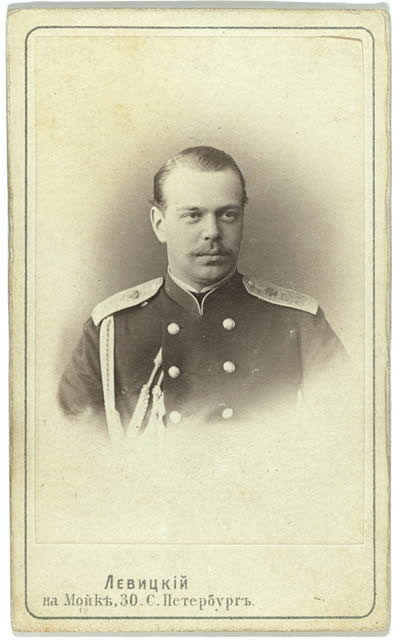 Czar Alexander III (1845-1894) He was at first admired by Clemens but was later on the receiving end of his hostility towards Russian monarchy. Photo from Library of Congress Prints and Photographs Division. |
_____
MARK TWAIN CHANGES HIS ATTITUDE
As Samuel Clemens cultivated his career as a successful writer and lecturer, he became more keenly aware of world politics. His attitude toward Russian monarchy shifted. Although he had devoted little attention to Russian politics between 1867 and 1881, a reading he delivered at the Hartford Monday Evening Club on March 22, 1886 indicates his opinion of the Russian aristocracy changed:
Power, when lodged in the hands of man, means oppression -- insures oppression: it means oppression always: … give it to the high priest of the Christian Church in Russia, the Emperor, and with a wave of his hand he will brush a multitude of young men, nursing mothers, gray headed patriarchs, gently young girls, like so many unconsidered flies, into the unimaginable hells of his Siberia, and go blandly to his breakfast, unconscious that he has committed a barbarity …(2).
_____
INFLUENCE OF GEORGE KENNAN
A continued hardening of Clemens's attitude against the Russian aristocracy, and indeed most of America's, can be traced to a series of articles commissioned by Richard Watson Gilder, editor of Century Illustrated Monthly Magazine.
Gilder hired American explorer and journalist George Kennan to travel to Siberia, a penal colony used for isolating Russians who voiced political opposition to the Czar. Kennan reported on the quality of life in the Siberian labor mining camps. Kennan's articles were published beginning in November 1887 and continued until April 1891. His reports in Century shocked Americans. Kennan returned to America a staunch supporter of a Russian revolution and traveled across the United States giving lectures accompanied by lantern slide shows which featured photographs of prisoners.
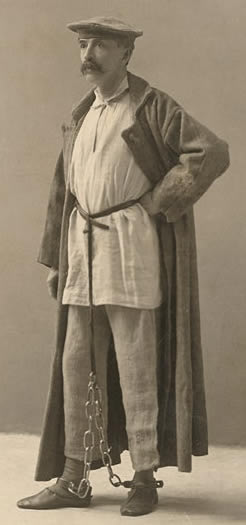
George Kennan dressed as prisoner in Siberia. Photo from Library of Congress Prints and Photographs Division
News reports indicate that Clemens was present at one of George Keenan's lectures as early as March 1888 and wept afterwards.
|
KANSAS CITY STAR, Saturday, April 7, 1888, p. 2. When Mark Twain Wept. There was a very dramatic scene at the meeting of the Literary society last Saturday evening. The members and their guests, including many distinguished personages, had gathered in the drawing-room. Presently the company saw a strange figure clad in wretched clothes and fettered with heavy chains standing in the doorway. For a moment his friends did not recognize it as Mr. George Kennan, the vice-president of the society, who had promised to read them some letters from Russian state prisoners in Siberia. The costume, and especially the chains, greatly heightened the effect of the letters, heartrending as some them were, and touching as all of them were in themselves. The thought that some of these simple stories of suffering were written by just such a refined and cultivated man as Kennan himself, and others by women even more refined and cultivated, was strongly impressed upon every one. "I feel completely unnerved," said Senator Hawley when Kennan had finished, and by so saying expressed the common thought. Mark Twain, who had actually been weeping, could not refrain from a more extended expression. Rising to his full height and speaking for once with seriousness, he said that were he a Russian he would be a revolutionist -- it would be inevitable. He might respect the czar as a man, but as a ruler he would destroy him. He believed that the moral power of the civilized world ought to be brought to bear upon Russia to put a speedy stop to such cruelties and outrages in the name of law. |
The following report from the Boston Daily Globe, February 26, 1889, p. 8 describes a typical Kennan lecture.
George Kennan's Lecture on Siberian Exiles.
Tears Fall as He Recites the Hardships of Political Convicts in the Mines.
Noble Self-Sacrifices by Those Whose Only Crime is Love of Country.
George Kennan's Siberian lecture in the Lowell Institute course delivered last evening was entitled "Political Convicts in the Mines." The profound interest in the subject taken by the well-informed and thinking people of Boston was attested in a marked manner by the crowd which attended last evening. Every foot of standing room in the aisles was occupied, some sat upon the window ledges, while others almost literally clung to the walls with their fingers and toes and a solid phalanx of ladies sat all around the edge of the rostrum, and though the regular seat-holders were considerable discomfited the delivery of the lectures was so satisfactory and the subject appealed so strongly to the tenderest feelings of everyone, that not a complaint or sign of dissatisfaction was shown.The lecture was almost entirely devoted to giving sketches of the lives of famous revolutionists serving long sentences in the mines of Kara, where prisoners were chained to wheelbarrows which could not be removed even at night.
One unusually humane officer, touched by the terrible sufferings of men whose only offenses had been a zeal for their country's happiness, had released them from the wheelbarrow chains, giving them the free use of their limbs, but the governor general of Eastern Siberia hearing of it, had ordered them restored. The humane officer reluctantly notified his captives of the renewed sufferings he was commanded to inflict upon them, and gave them three days in which to prepare for the new order of things.
The kind-hearted officer, unable to stand the scenes of suffering, resigned his command with the hope that he might be transferred to some more congenial department; but was told by the governor general that such a man as he was unfit to hold any position under the government.
Terrible tragedies followed. Several men and women shot themselves, or drank poison made by soaking matches in water, while others became hopeless maniacs.
Brief and most tragic histories were related of the lives of the following prisoners at the prison of Kara, all of whom were refined and cultured men and women. Several of the notable families: Anna Pavlovan Korba, Mme. Kavalef Skayn, Dr. Edward Volmar, Mme. Yakimova and her child, and Eugene Semyanofski.
Impressive photographic portraits of all the characters referred to were thrown upon the screen and their strong and handsome features were gazed at by the large audience with an intense though sad interest.
The lecturer said that political prisoners on the way to Siberia are always photographed somewhere on the march, in order that if they escape their portraits may be sent in every direction, to aid in their capture; and the photographs which Mr. Kennan procured were got by bribing the photographers, who ran grave risks in parting with them.
Teams came to the eyes of many of the auditors at the recital of grievous incidents in the stories of the several unfortunates, and one of the most pathetic incidents mentioned was that of a little boy, born in prison of a noble captive mother, and who entertained the greatest fear of any man not wearing a soldier's uniform. The child knew no other life than that of the prison, and the only persons whom he had confidence in were the men who held his mother a prisoner.
He spoke to Mr. Kennan of his mother's life in the mines, and of his father's captivity in another prison 1000 miles away, and with smiling face and without any conception of any other existence.
Among the heart-rending incidents of life in the mines of Kara, was the description of hunger strikes by the women, who, in efforts to force the officers to allow them to associate together instead of being isolated, had abstained from eating, voluntarily starving themselves for 17 days upon one occasion, at the expiration of which time a physician was sent to them with appliances for injection and orders to force them to take sustenance. One of the women fell upon her knees and begged the physician by the memory of her mother, his sister and his wife, not to inflict upon them such an outrage. He was touched by her entreaties, and succeeded in so influencing the officers that the women won the strike after 17 days of fasting, and when they were so weak as to be hardly capable of doing anything for themselves.
Pictures of the prison were shown which appeared to be long one-story buildings, built like an ordinary log house. The internal arrangements consisting of a corridor running the full length of the building, with several large coils on each side, each one accommodating many prisoners. The rude windows look out upon a yard formed by the erection of a high stockade. The stockade is a recent adoption, brought about by a visiting inspector, who said grimly while looking from one of the windows out upon the street: "H'm, this prison is too much like a palace." So all view was shut off by the erection of the stockade.
One of the most profoundly interested and affected auditors present last evening was a Russian student at Harvard, who has a brother serving a sentence at Kara. The enthusiasm displayed during the lecture was in marked contrast to anything seen at the general run of lectures in the Lowell Institute course and every allusion to the noble self-sacrifice of the exiles in Siberia, and their efforts to establish a constitutional government in place of the present autocracy of the Czar was greeted with an electrical and rousing response.
The last lecture in the course will be given on Wednesday evening.
Some sources indicate that Clemens attended one of Kennan's six lectures at Lowell Institute and afterwards, in a voice choked with tears, exclaimed "If such a government cannot be overthrown otherwise than by dynamite, then thank God for dynamite" (3). With a steady stream of publicity in the Century and Kennan's lectures, the American public came to accept assassination as an acceptable means of political reform in Russia.
_____
MARK TWAIN'S ATTITUDE SET IN INK
Anti-czarist comments in Mark Twain's writings appear more frequently in his work after George Kennan's publicity tours. In Captain Stormfield's Visit to Heaven, a manuscript he worked on for over thirty years he compared heaven to Russia:
Well, this is Russia -- only more so. There's not the shadow of a republic about it anywhere (4).
Clemens completed A Connecticut Yankee in King Arthur's Court in April 1889. Mark Twain scholar Howard Baetzhold theorized that George Kennan's illustrated articles and his visual descriptions of Siberian exiles in the Century were sources for the descriptions of slaves in Connecticut Yankee (4a).
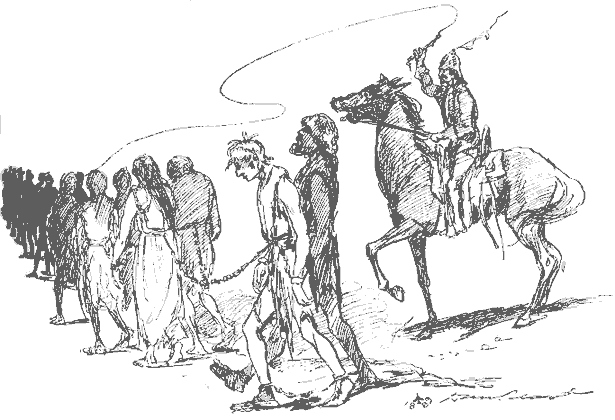
Dan Beard's illustration
of the Yankee and the King sold as slaves,
from chapter 34, A Connecticut Yankee in King Arthur's Court.
Clemens did not include the preface he had originally written for the book. It was published after his death by his biographer Albert Bigelow Paine:
I have drawn no laws and no illustrations from the twin civilizations of hell and Russia. To have entered into that atmosphere would have defeated my purpose, which was to show a great and genuine progress in Christendom in these few later generations toward mercifulness -- a wide and general relaxing of the grip of the law. Russia had to be left out because exile to Siberia remains, and in that single punishment is gathered together and concentrated all the bitter inventions of all the black ages for the infliction of suffering upon human beings. Exile for life from one's hearthstone and one's idols -- this is rack, thumb-screw, the water-drop, fagot and stake, tearing asunder by horses, flaying alive -- all these in one; and not compact into hours, but drawn out into years, each year a century, and the whole a mortal immortality of torture and despair. While exile to Siberia remains one will be obliged to admit that there is one country in Christendom where the punishments of all the ages are still preserved and still inflicted, that there is one country in Christendom where no advance has been made toward modifying the medieval penalties for offenses against society and the State (5).
In November 1889 Brazil overthrew their monarch Dom Pedro in a bloodless revolution that was called "the most peaceful revolution of the century." The news delighted Clemens and he expressed his continuing contempt for the remaining monarchs of Europe in a letter dated November 20, 1889 to Sylvester Baxter of the Boston Herald:
DEAR MR. BAXTER -- Another throne has gone down, and I swim in oceans of satisfaction. I wish I might live fifty years longer; I believe I should see the thrones of Europe selling at auction for old iron. I believe I should really see the end of what is surely the grotesquest of all the swindles ever invented by man -- monarchy. It is enough to make a graven image laugh, to see apparently rational people, away down here in this wholesome and merciless slaughter-day for shams, still mouthing empty reverence for those moss-backed frauds and scoundrelisms, hereditary kingship and so-called "nobility." It is enough to make the monarchs and nobles themselves laugh -- and in private they do; there can be no question about that. I think there is only one funnier thing, and that is the spectacle of these bastard Americans -- these Hamersleys and Huntingtons and such -- offering cash, encumbered by themselves, for rotten carcases and stolen titles. When our great brethren the disenslaved Brazilians frame their Declaration of Independence, I hope they will insert this missing link: "We hold these truths to be self-evident: that all monarchs are usurpers, and descendants of usurpers; for the reason that no throne was ever set up in this world by the will, freely exercised, of the only body possessing the legitimate right to set it up -- the numerical mass of the nation."
You already have the advance sheets of my forthcoming book in your hands. If you will turn to about the five hundredth page, you will find a state paper of my Connecticut Yankee in which he announces the dissolution of King Arthur's monarchy and proclaims the English Republic. Compare it with the state paper which announces the downfall of the Brazilian monarchy and proclaims the Republic of the United States of Brazil, and stand by to defend the Yankee from plagiarism. There is merely a resemblance of ideas, nothing more. The Yankee's proclamation was already in print a week ago. This is merely one of those odd coincidences which are always turning up. Come, protect the Yank from that cheapest and easiest of all charges -- plagiarism. Otherwise, you see, he will have to protect himself by charging approximate and indefinite plagiarism upon the official servants of our majestic twin down yonder, and then there might be war, or some similar annoyance.
Have you noticed the rumor that the Portuguese throne is unsteady, and that the Portuguese slaves are getting restive? Also, that the head slave-driver of Europe, Alexander III, has so reduced his usual monthly order for chains that the Russian foundries are running on only half time now? Also that other rumor that English nobility acquired an added stench the other day -- and had to ship it to India and the continent because there wasn't any more room for it at home? Things are working. By and by there is going to be an emigration, may be. Of course we shall make no preparation; we never do. In a few years from now we shall have nothing but played-out kings and dukes on the police, and driving the horse-cars, and whitewashing fences, and in fact overcrowding all the avenues of unskilled labor; and then we shall wish, when it is too late, that we had taken common and reasonable precautions and drowned them at Castle Garden (5a).
Clemens continued to vent his rage at the Russian regime in 1890 in writings that were not published until after his death. A mock communication from Alexander III is another example published by Paine after his death.
ST. PETERSBURG, February.
COL. MARK TWAIN, Washington.Your cablegram received. It should have been transmitted through my minister, but let that pass. I am opposed to international copyright. At present American literature is harmless here because we doctor it in such a way as to make it approve the various beneficent devices which we use to keep our people favorable to fetters as jewelry and pleased with Siberia as a summer resort. But your bill would spoil this. We should be obliged to let you say your say in your own way. Voila! my empire would be a republic in five years and I should be sampling Siberia myself.
If you should run across Mr. Kennan please ask him to come over and give some readings. I will take good care of him.
ALEXANDER III.
144 -- Collect (6)
In the summer of 1890 Clemens wrote "The Answer," a manuscript not yet published outside of the microfilm edition of the Mark Twain Papers. It is a burlesque reply from Alexander III to "Impertinent Republican Scum" admitting the charges of which George Kennan has accused him and sneering at his foreign critics.
_____
AN UNSENT LETTER TO THE EDITOR OF FREE RUSSIA, 1890
In the summer of 1890 Clemens also composed a letter which he never mailed to the editor of the publication Free Russia which advocated Russian reforms. Twain's support of violence to overthrow the Czar along with his impatience with the Russian people for tolerating abuses was evident.
To the Editor of Free Russia,
I thank you for the compliment of your invitation to say something, but when I ponder the bottom paragraph on your first page, and then study your statement on your third page, of the objects of the several Russian liberation-parties, I do not quite know how to proceed. Let me quote here the paragraph referred to:
"But men's hearts are so made that the sight of one voluntary victim for a noble idea stirs them more deeply than the sight of a crowd submitting to a dire fate they cannot escape. Besides, foreigners could not see so clearly as the Russians how much the Government was responsible for the grinding poverty of the masses; nor could they very well realize the moral wretchedness imposed by that Government upon the whole of educated Russia. But the atrocities committed upon the defenceless prisoners are there in all their baseness, concrete and palpable, admitting of no excuse, no doubt or hesitation, crying out to the heart of humanity against Russian tyranny. And the Tzar's Government, stupidly confident in its apparently unassailable position, instead of taking warning from the first rebukes, seems to mock this humanitarian age by the aggravation of brutalities. Not satisfied with slowly killing its prisoners, and with burying the flower of our young generation in the Siberian desserts, the Government of Alexander III resolved to break their spirit by deliberately submitting them to a regime of unheard-of brutality and degradation."
When one reads that paragraph in the glare of George Kennan's revelations, and considers how much it means; considers that all earthly figures fail to typify the Czar's government, and that one must descend into hell to find its counterpart, one turns hopefully to your statement of the objects of the several liberation-parties -- and is disappointed. Apparently none of them can bear to think of losing the present hell entirely, they merely want the temperature cooled down a little.
I now perceive why all men are the deadly and uncompromising enemies of the rattlesnake: it is merely because the rattlesnake has not speech. Monarchy has speech, and by it has been able to persuade men that it differs somehow from the rattlesnake, has something valuable about it somewhere, something worth preserving, something even good and high and fine, when properly "modified," something entitling it to protection from the club of the first comer who catches it out of its hole. It seems a most strange delusion and not reconcilable with our superstition that man is a reasoning being. If a house is afire, we reason confidently that it is the first comer's plain duty to put the fire out in any way he can -- drown it with water, blow it up with dynamite, use any and all means to stop the spread of the fire and save the rest of the city. What is the Czar of Russia but a house afire in the midst of a city of eighty millions of inhabitants? Yet instead of extinguishing him, together with his nest and system, the liberation-parties are all anxious to merely cool him down a little and keep him.
It seems to me that this is illogical -- idiotic, in fact. Suppose you had this granite-hearted, bloody-jawed maniac of Russia loose in your house, chasing the helpless women and little children -- your own. What would you do with him, supposing you had a shotgun? Well, he is loose in your house -- Russia. And with your shotgun in your hand, you stand trying to think up ways to modify" him.
Do these liberation-parties think that they can succeed in a project which has been attempted a million times in the history of the world and has never in one single instance been successful -- the "modification" of a despotism by other means than bloodshed? They seem to think they can. My privilege to write these sanguinary sentences in soft security was bought for me by rivers of blood poured upon many fields, in many lands, but I possess not one single little paltry right or privilege that come to me as a result of petition, persuasion, agitation for reform, or any kindred method of procedure. When we consider that not even the most responsible English monarch ever yielded back a stolen public right until it was wrenched from them by bloody violence, is it rational to suppose that gentler methods can win privileges in Russia?
Of course I know that the properest way to demolish the Russian throne would be by revolution. But it is not possible to get up a revolution there; so the only thing left to do, apparently, is to keep the throne vacant by dynamite until a day when candidates shall decline with thanks. Then organize the Republic. And on the whole this method has some large advantages; for whereas a revolution destroys some lives which cannot well be spared, the dynamite way doesn't. Consider this: the conspirators against the Czar's life are caught in every rank of life, from the low to the high. And consider: if so many take an active part, where the peril is so dire, is this not evidence that the sympathizers who keep still and do not show their hands, are countless for multitudes? Can you break the hearts of thousands of families with the awful Siberian exodus every year for generations and not eventually cover all Russia from limit to limit with bereaved fathers and mothers and brothers and sisters who secretly hate the perpetrator of this prodigious crime and hunger and thirst for his life? Do you not believe that if your wife or your child or your father was exiled to the mines of Siberia for some trivial utterances wrung from a smarting spirit by the Czar's intolerable tyranny, and you got a chance to kill him and did not do it, that you would always be ashamed to be in your own society the rest of your life? Suppose that that refined and lovely Russian lady who was lately stripped bare before a brutal soldiery and whipped to death by the Czar's hand in the person of the Czar's creature had been your wife, or your daughter or your sister, and to-day the Czar should pass within reach of your hand, how would you feel -- and what would you do? Consider, that all over vast Russia, from boundary to boundary, a myriad of eyes filled with tears when that piteous news came, and through those tears that myriad of eyes saw, not that poor lady, but lost darlings of their own whose fate her fate brought back with new access of grief out of a black and bitter past never to be forgotten or forgiven.
If I am a Swinburnian -- and clear to the marrow I am -- I hold human nature in sufficient honor to believe there are eighty million mute Russians that are of the same stripe, and only one Russian family that isn't.
Mark Twain (7).
_____
REVISED CHRISTMAS GREETINGS, 1890
When asked to contribute a Christmas greeting that could be published in newspapers at the end of December 1890, Clemens composed the following which appeared in the Boston Daily Globe on December 25, 1890:
Boston Daily Globe, December 25, 1890, p. 3
CHRISTMAS GREETINGS
...
Mark TwainIt is my heart-warm and world-embracing Christmas hope and aspiration that all of us, the high, the low, the rich, the poor, the admired, the despised, the loved, the hated, the civilized, the savage, may eventually be gathered together in a heaven of everlasting rest and peace and bliss, escape [sic] the inventor of the telephone.
MARK TWAIN.
Hartford, Dec. 23
He was later quoted as saying:
I had no intention of reflecting on the inventor of the telephone when I started to write. I intended to wish everyone a Happy New Year, with the exception of the Emperor of Russia …Just then the telephone rang … and I went to the telephone and, as usual, lost my temper … I hung up the telephone in disgust and went back to my writing, and instead of the Emperor of Russia I put in the inventor of the telephone (8).
An unpublished version of the quote "extends a Merry Christmas to all deserving people while remanding others to the arms of Satan or the Emperor of Russia, according to their preference" (9).
_____
"LETTERS FROM A DOG," JANUARY - FEBRUARY 1891
In an essay not published in his lifetime, Clemens wrote "Letters from a Dog to Another Dog Explaining and Accounting for Man" in the early months of 1891. Decrying the brutal nature of man and monarchy, He denounced the Russian czar as an example.
Consider the Czar of Russia. His powers are a theft to-day, just as they were when they came originally into his family. His portrait hangs everywhere that you may go, throughout his dominions. His eighty million slaves, instead of being privileged to clod it with mud wherever they find it, and say "This is the posterity of that highwayman that robbed our fathers," are actually required to take their hats off when they come into its presence, and humbly salute it. ... The Czar requires every Russian to spend the fifteen best and most efficient years of his life in the army; and then turns him adrift without pension and ignorant of all ways of sustaining life except by killing people. (9a)
"Letters from a Dog to Another Dog Explaining and Accounting for Man" was first published in print in 2009 and included in Mark Twain's Book of Animals (University of California Press) and provides further evidence that Mark Twain's animosity to the Russian government permeated those essays he chose never to print..
_____
STEPNIAK'S VISIT, APRIL 1891
The publication Free Russia was first established in England in 1890 by the English Friends of Russian Freedom in coordination with Russian revolutionary Sergei Kravchinski, an author who advocated political terrorism. Kravchinski had killed the Russian chief of secret police in St. Petersburg in 1878. After leaving Russia, he eventually settled in London and wrote under the name of Sergius Stepniak. By the 1880s English translations of his books were published by Harper and Brothers and other prominent American publishing houses. In November 1888, Clemens's colleague William Dean Howells had written a favorable review of Stepniak's The Russian Peasant. In 1891 when Stepniak traveled to Boston seeking additional support from Americans for the Russian revolution he visited with Howells. Howells, in turn, provided him with a letter of introduction to Clemens. Stepniak visited Clemens in April 1891.
By the end of April, Stepniak had succeeded in organizing the Society of American Friends of Russian Freedom and an American edition of Free Russia began publication in July 1891. Along with Clemens, other the prominent members of the American Society were Lyman Abbot, Alice Stone Blackwell, William Lloyd Garrison, Thomas Wentworth Higginson, Julia Ward Howe, George Kennan, James Russell Lowell, Hamilton W. Mabie, Alice Freeman Palmer and Frank B. Sanborn. George Kennan translated documents for Free Russia and Alice Blackwell served as head of the news bureau (10). Stepniak returned to London by the end of 1891 where he was killed in a train accident a few years later on December 23, 1895.
_____
THE AMERICAN CLAIMANT, 1891
Coinciding with the visit of Stepniak in early 1891 was Mark Twain's work on The American Claimant. The book is peppered with references to Siberia and Russian tyranny. In chapter 18 he has his protagonist Colonel Sellers proposing to buy Siberia:
Where is the place where there is twenty-five times more manhood, pluck, true heroism, unselfishness, devotion to high and noble ideals, adoration of liberty, wide education, and brains, per thousand of population, than any other domain in the whole world can show?"
"Siberia!"
"Right."
"It is true; it certainly is true, but I never thought of it before."
"Nobody ever thinks of it. But it's so, just the same. In those mines and prisons are gathered together the very finest and noblest and capablest multitude of human beings that God is able to create. Now if you had that kind of a population to sell, would you offer it to a despotism? No, the despotism has no use for it; you would lose money. A despotism has no use for anything but human cattle. But suppose you want to start a republic?"
"Yes, I see. It's just, the material for it."
"Well, I should say so! There's Siberia with just the very finest and choicest material on the globe for a republic, and more coming -- more coming all the time, don't you see! It is being daily, weekly, monthly recruited by the most perfectly devised system that has ever been invented, perhaps. By this system the whole of the hundred millions of Russia are being constantly and patiently sifted, sifted, sifted, by myriads of trained experts, spies appointed by the Emperor personally; and whenever they catch a man, woman or child that has got any brains or education or character, they ship that person straight to Siberia. It is admirable, it is wonderful. It is so searching and so effective that it keeps the general level of Russian intellect and education down to that of the Czar" (11).
The American Claimant was serialized in the Sunday edition of the New York Sun in early 1892 and in various McClure syndications as well as England's Idler.
_____
TOM SAWYER ABROAD, 1892
In June 1891 financial reverses forced Clemens to close his home in Hartford, Connecticut and move to Europe with his family. His notebooks from that time period contain occasionally references to Russia. One September 9, 1891 he wrote:
The idiotic Crusades were gotten up to 'rescue' a valueless tomb from the Saracens. It seems to me that a crusade to make a bonfire of the Russian throne & fry the Czar in it wd have some sense (12).
In 1892, Clemens, living in Germany at the time, responded to an offer from Mary Mapes Dodge to write a story for St. Nicholas Magazine. He completed "Tom Sawyer Abroad" in the fall of 1892. His impatience with the Russian population's inability to overthrow the Czar was evident in that story:
And look at Russia. It spreads all around and everywhere, and yet ain't no more important in this world than Rhode Island is, and hasn't got half as much in it that's worth saving (13).
_____
EXTRADITION TREATY WITH RUSSIA 1893
In February 1893 the United States Congress passed a controversial extradition treaty with Russia which made the attempted assassination of the Czar or his members of his family a nonpolitical crime. Russia had lobbied for the treaty since 1886. Many Americans opposed this extradition treaty on the grounds that it threatened Russian political exiles who had sought refuge in the United States. Russian revolutionaries seeking asylum in the United States were in danger of being extradited. The Society of the American Friends of Russian Freedom opposed the treaty without success and the American edition of Free Russia ceased publication in July 1894.
_____
"DARKEST RUSSIA"
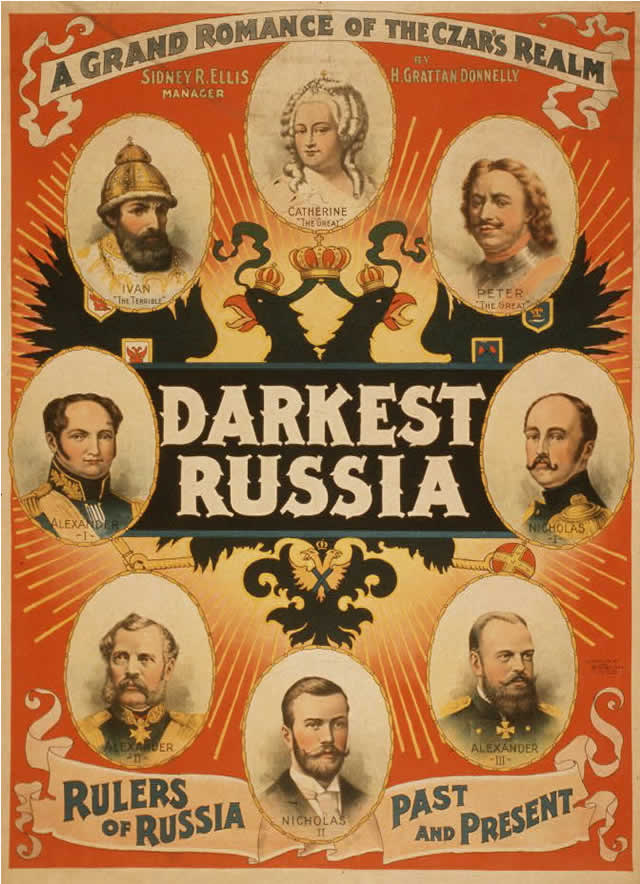
In the latter half of the 1890s the American public continued to be reminded of Russian despotism through various media. In January 1894 the play "Darkest Russia" by Henry Grattan Donnelly began playing in New York. The play featured scenes in a St. Petersburg palace, Nihilists headquarters, and a Siberian exile station. The plot of the play revolved around the arrest and transportation to Siberia of innocent persons present at a revolutionary gathering. A reviewer for the New York Times described it as a "fine old melodrama of the blood-curdling sort" (14).
Poster from the play "Darkest Russia" from Library of Congress Prints and Photographs Division.
In November 1894, Czar Alexander III died from kidney disease and his son Nicholas II became Czar. Some Americans were willing to take a "wait and see" attitude regarding Nicholas II until it became apparent no democratic reforms would be forthcoming. The advertising posters for "Darkest Russia" featured Nicholas II's portrait in 1895 -- an indication that American expectations for quick reforms had died. "Darkest Russia" played on American stages through at least 1904.
In 1898 Samuel Clemens and his family were living in Vienna, Austria. On October 30, 1898, the Philadelphia Inquirer, along with other American newspapers, featured a report datelined London, October 29, reporting that Mark Twain was planning a visit to St. Petersburg. A newspaper of that city, the Petersburgsky Listok announced that several humorists of St. Petersburg were preparing to celebrate his visit with a banquet. The visit never materialized.
_____
MARK TWAIN'S CONTINUING RANDOM SHOTS AT RUSSIA, 1900-1902
Clemens and his family returned to the United States in October 1900. His next public swing at Russia came in a speech delivered at the annual meeting of the New York Public Education Association on November 23, 1900. His speech was filled with anti-imperialistic sentiments and he complained that Russia had 30,000 soldiers in Manchuria who should be sent back home to farms to live in peace. He concluded that the New York Public Education Association was "much wiser in its day and generation than the Emperor of Russia and all his people" (15).
Clemens continued to criticize Russia for imperialistic expansion in Manchuria at least twice more before the end of 1900. In a speech given on December 12, 1900 while introducing Winston Churchill at the Waldorf Astoria in New York he criticized both Britain and the United States saying:
We both stood timorously be at Port Arthur and wept sweetly and sympathizingly and shone while France and Germany helped Russia to rob the Japanese (16).
In "A Salutation Speech from the Nineteenth Century to the Twentieth," published in the New York Herald on December 30, 1900 Mark Twain again criticized Russia's "pirate raids in Manchuria."
In his essay "To the Person Sitting in Darkness," published in the February 1901 issue of North American Review he wrote of Russia:
…she seizes Manchuria, raids its villages, and chokes its great river with the swollen corpses of countless massacred peasants ...(17).
Also written about the same time as "To the Person Sitting in Darkness" was an essay titled "The Stupendous Procession" which was not published in Clemens's lifetime. For a parade of countries in the twentieth century, he described Russia:
Weary Column of Exiles - Women, Children, Students, Statesmen, Patriots, stumbling along in the snow;
Mutilated Figure in Chains, labeled "Finland"
Floats piled with Bloated Corpses - Massacred Manchurian peasants (18)
Mark Twain's short story "The Belated Russian Passport" was published in Harper's Weekly on December 6, 1902. The story features a young man undergoing anxiety attacks as he is fears expulsion to Siberia if he cannot produce a passport while traveling to St. Petersburg.
In a few hours I shall be one of a nameless horde plodding the snowy solitudes of Russia, under the lash, and bound for that land of mystery and misery and termless oblivion, Siberia! I shall not live to see it; my heart is broken and I shall die (19).
_____
RUSSO-JAPANESE WAR AND "THE CZAR'S SOLILOQUY"
In February 1904 the Russo-Japanese war broke out, brought about by Russia's attempts to maintain a warm water seaport in the south of Manchuria. Japan mounted successful defeats of the Russian army and confidence in Czar Nicholas II's leadership continued to decline in Russia.
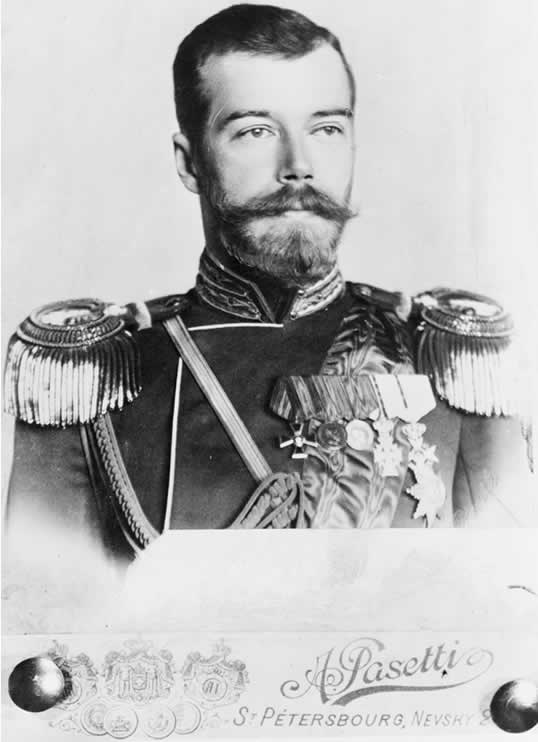
Czar Nicholas II (1868-1918)
Leader of Russia during the Russo-Japanese War was in power when Mark Twain wrote "The Czar's Soliloquy" which advocated assassination of the Czar and his family.
Photo from Library of Congress Prints and Photographs Division.
Clemens and his family were living in Italy in 1904. William Lyon Phelps recalls visiting with him on April 14, 1904:
He was 68 years old, but looked older; his wife was desperately ill and indeed died in this villa Sunday 5 June. During this hour's interview, Mark smoked three cigars; there was a constant twitching in his right cheek and his right eye seemed inflamed. He was excited about the Russo-Japanese War, and was an intense partisan of the Japanese. I told him that Edith M. Thomas had published a poem calling on Americans to support the Russians because they were Christians and the Japanese heathens; and he replied, 'Edith doesn't know what she's talking about.' He pretended to believe the Russians had made a fatal error and shown lack of judgement in not sending a sufficient number of ikons with their soldiers. 'Why,' speaking with great emphasis, 'I read that they have sent out only eighty holy images with their troops! General Kuropatkin ought to have carried at least 800!' (19a)
On January 22, 1905 Russian laborers marched with a petition for reforms to the Czar's Winter Palace in St. Petersburg. In a skirmish with police and Cossack guards, over one hundred workers were killed and three hundred wounded. The incident was headlined around the world and became known in history as "Bloody Sunday." American journalists such as William English Walling, grandson of William Hayden English, Unites States Vice Presidential candidate in 1880; Samuel S. McClure, founder of McClure's Magazine; Arthur Bullard, and Ernest Poole went abroad to cover the Russian revolution for American magazines and newspapers.
On January 23, The New York Times reported, "The blood which crimsoned the snow has fired the brains and passions of the strikers and turned women as well as men into wild beasts, and the cry of the infuriated populace is for vengeance." The same article quoted Maxim Gorky, the Russian novelist, "To-day inaugurated revolution in Russia. The Emperor's prestige will be irrevocably shattered by the shedding of innocent blood. He has alienated himself forever from his people" (20).
Clemens had returned to America after his wife's death. His response to the "Bloody Sunday" massacres was an essay titled "The Czar's Soliloquy" which he dated February 2, 1905. It was published in the North American Review the following month March 1905. In the sketch he strikes out at moralists who have not supported assassination of the royal family:
A strange thing, when one considers it: to wit, the world applies to Czar and System the same moral axioms that have vogue and acceptance in civilized countries! Because, in civilized countries, it is wrong to remove oppressors otherwise than by process of law, it is held that the same rule applies in Russia, where there is no such thing as law -- except for our Family. Laws are merely restraints -- they have no other function. In civilized countries they restrain all persons, and restrain them all alike, which is fair and righteous; but in Russia such laws as exist make an exception -- our Family. We do as we please; we have done as we pleased for centuries. Our common trade has been crime, our common pastime murder, our common beverage blood -- the blood of the nation. Upon our heads lie millions of murders. Yet the pious moralist says it is a crime to assassinate us. We and our uncles are a family of cobras set over a hundred and forty million rabbits, whom we torture and murder and feed upon all our days; yet the moralist urges that to kill us is a crime, not a duty (21).
Clemens's original manuscript indicates he was much more vehement in his call for assassination of the Czar than his published version. He urges Russian mothers to teach their children:
When you grow up, knife a Romanoff wherever you find him, loyalty to these cobras is treason to the nation; be a patriot, not a prig - set the people free (22).
He also wrote another manuscript which he first titled "A Difficult Conundrum" and later changed to "Flies and Russians" about the same time he wrote "The Czar's Soliloquy." An examination of the original manuscripts indicates that he may have intended to combine the two manuscripts into one but later changed his mind. "Flies and Russians" was not published during his lifetime. It was later published in 1972 in the collection Mark Twain's Fables of Man. In "Flies and Russians" Twain shows his impatience with the Russian people who appear to be too cowardly to obtain their independence and to a creator who made them.
We have the flies and the Russians, we cannot help it, let us not bemoan about it, but manfully accept the dispensation and do the best we can with it. Time will bring relief, this we know, for we have history for it. Nature had made many and many a mistake before she added flies and Russians, and always she corrected them as soon as she could. She will correct this one too -- in time. Geological time.
He concluded this manuscript by adding:
Even in our own day Russians could be made useful if only a way could be found to inject some intelligence into them. How magnificently they fight in Manchuria! With what indestructible pluck they rise up after the daily defeat, and sternly strike, and strike again! how gallant they are, how devoted, how superbly unconquerable! If they would only reflect! if they could only reflect! if they only had something to reflect with! Then these humble and lovable slaves would perceive that the splendid fighting-energy which they are wasting to keep their chipmunk on the throne would abolish both him and it if intelligently applied (23).
In latter May and early June 1905 the New York papers reported on Japan's successful naval battles against the Russians under the leadership of Admiral Togo. The Russian naval fleet was destroyed in the battle of Tsushima on May 27. The news delighted Clemens who wrote to his friend Joseph Twichell:
Togo forever! I wish somebody would assassinate the Russian Family. So does every sane person in the world - but who has the grit to say so? Nobody … (24).
_____
A JAB AT PRAYING FOR RUSSIAN VICTORIES AND CHRISTIAN SCIENCE
In June 1905 Clemens was working on a manuscript titled No. 44, The Mysterious Stranger. He took the opportunity of the Russian naval defeat to ridicule Christians who had prayed for a Russian victory. Mary Baker Eddy, founder of the Christian Science movement published a telegram to her followers which was widely published in American newspapers:
| Here, O Israel, the Lord God is one Lord. I now request that the members of my Church cease special prayer for the peace of nations, and cease in full faith that God does not hear our prayers only because of oft speaking; but that He will bless all the inahbitants of the earth, and 'none can stay His hand nor say unto Him what doest thou.' Out of His allness He must bless all with His own truth and love. MARY BAKER G. EDDY. Pleasant View, Concord, N.H., June 27, 1905. |
Clemens ridiculed Eddy's telegram refering to her as the founder of "Christian Silence." Criticizing the wording of her telegram, he wrote:
Down to the word 'nations' anybody can understand it. There's been a prodigious war going on for about seventeen months, with destruction of whole fleets and armies, and in seventeen words she indicates certain things, to-wit: I believed we could squelch the war with prayer, therefore I ordered it; it was an error of Mortal Mind, whereas I had supposed it was an inspiration; I now order you to cease from praying for peace and take hold of something nearer our size, such as strikes and insurrections.... It seems to mean that He does not listen to our prayers any more because we pester Him too much. This carries us to the phrase of 'oft-speaking.' At that point the fog shuts down, black and impenetrable, it solidifies into uninterpretable irrelevances. Now then, you add up, and get these results: the praying must be stopped -- which is clear and definite; the reason for the stoppage is -- well, uncertain. ... If you put part of the message in school-girl and the rest in Choctaw, the interpreter is going to be defeated, and colossal harm can come of it. ... What is His allness?" ... It probably means that she entered the game because she thought only His halfness was in it and would need help; then perceiving that His allness was there and playing on the other side, she considered it best to cash-in and draw out. I think that must be it; it looks reasonable, you see, because in seventeen months she hadn't put up a single chip and got it back again, and so in the circumstances it would be natural for her to want to go out and see a friend (24a).
_____
TREATY OF PORTSMOUTH 1905
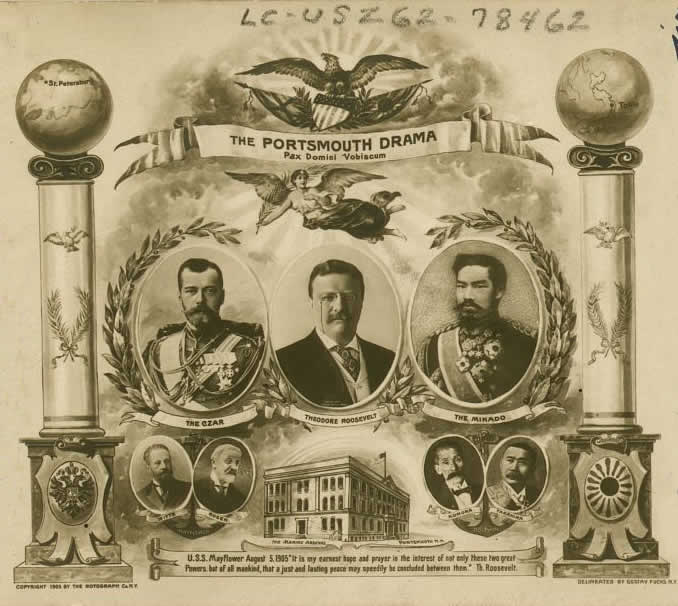
United States President Theodore Roosevelt mediated a peace settlement of the Russo-Japanese War in late August 1905 at Portsmouth, New Hampshire. When the peace settlement had been reached, the Boston Globe telegraphed prominent Americans asking for their reaction. Mark Twain's response, published by the Globe on August 30, 1905, was a dissenting voice among the numerous congratulations. Clemens was summering in Dublin, New Hampshire at the time and transmitted the following response:
DURHAM, N. H., Aug 29 -- To the Editor of the Globe:
Russia was on the high road to emancipation from an insane and intolerable slavery; I was hoping there would be no peace until Russian liberty was safe. I think that this was a holy war in the best and noblest sense of that abused term, and that no war was ever charged with a higher mission; I think there can be no doubt that that mission is now defeated and Russia's chains re-riveted, this time to stay.
I think the czar will now withdraw the small humanities that have been forced upon him, and resume his medieval barbarisms with a relieved spirit and an immeasurable joy. I think Russian liberty had had its last chance, and has lost it.
I think nothing has been gained by the peace that is remotely comparable to what has been sacrificed by it. One more battle would have abolished the waiting chains of billions upon billions of unborn Russians, and I wish it could have been fought.
I hope I am mistaken, yet in all sincerity I believe that this peace is entitled to rank as the most conspicuous disaster in political history.
MARK TWAIN (25)
He would later recall, "No one in all this nation except Doctor Seaman and myself uttered a public protest against this folly of follies" (26). Dr. Louis Livingston Seaman, a military doctor and surgeon who had recently spent six months in Manchuria had also refused to add his voice to the praise given to President Roosevelt. Seaman felt that the peace settlement would only allow Russia to recuperate sufficiently for another future struggle towards imperialism in the direction of China and the Pacific coast. Dr. Seaman's anti-imperialist views reflected many also held by Mark Twain (27).
The Treaty of Portsmouth was signed September 5, 1905. As a result, Japan received concessions and came to be recognized as a world power. Czar Nicholas II, in turn, was once again able to refocus on his own domestic problems. President Theodore Roosevelt was later awarded the Nobel Peace Prize for engineering an end to the hostilities.
Detail of postcard from the 1905 Portsmouth Conference
from Library of Congress Prints and Photographs Division.
When political journalist Colonel George Harvey invited Clemens to dinner with the Russian representatives to the Portsmouth conference, Clemens carefully composed two telegrams before finally settling on a third version which he knew would be acceptable.
Dublin, N.H.
September 5, 1905TO COLONEL HARVEY. - I am still a cripple, otherwise I should be more than glad of this opportunity to meet those illustrious magicians who with the pen have annulled, obliterated and abolished every high achievement of the Japanese sword and turned the tragedy of a tremendous war into a gay and blithesome comedy. If I may, let me in all respect and honor salute them as my fellow-humorists, I taking third place, as becomes one who was not born to modesty, but by diligence and hard work is acquiring it.
MARK.
~~~~~
Dublin, N.H.
September 5, 1905DEAR COLONEL. -- No, this is a love-fest; when you call a lodge of sorrow send for me.
~~~~~
Clemens finally sent Harvey the following third version of his response. Author and Mark Twain biographer Van Wyck Brooks argued that the rewording was evidence that Clemens suppressed opinions in order to cater to public opinion. Other scholars such as Louis J. Budd have found the wording to be ironic and ambiguous.
Dublin, N.H.
September 5, 1905TO COLONEL HARVEY. -- I am still a cripple, otherwise I should be more than glad of this opportunity to meet the illustrious magicians who came here equipped with nothing but a pen, and with it have divided the honours of the war with the sword. It is fair to presume that in thirty centuries history will not get done admiring these men who attempted what the world regarded as impossible and achieved it.
MARK TWAIN.
Harvey later reported that Clemens's response pleased the Russians and his response would be hand delivered to the Czar (28).
A few months later Clemens met with reporters when he was visiting in Boston with stockbroker Sumner B. Pearmain. On the subject of Russia, the Boston Journal of November 6, 1905 quoted him:
I was really sorry when I heard there was to be peace between Russia and Japan. I thought if there was another battle the dissatisfaction would be so strong at home the government would have to give in to freedom. A few days ago when I read a constitution had been granted I began to think I had been too hasty, but now I don't feel so sure of it. As long as the army, and navy, and treasury are in the hands of the Czar the constitution don't amount to anything; nothing is accomplished today. … The Czar is in a hole, but not a bottomless hole. He's only waiting for a few years till the people get pacified and then he'll take back, one by one, the things he has doled out. Russia is a country by itself. When it talks about honor it is like any other pauper talking about money (29).
Clemens continued to lend his support to causes supporting Russian freedom. In a Thanksgiving message published in November 1905 he theorized how God would view a recent Russian massacre of 50,000 Jews. In December 1905 when New York society leaders held a benefit for the aid of Jewish victims of the failed Russian revolution earlier in the year, Clemens shared the honor of headlining the event along with actress Sarah Bernhardt. However, his speech for the event was light and humorous and made no mention of atrocities committed by the ruling aristocracy.
After the Treaty of Portsmouth was signed Czar Nicholas II promised constitutional reforms and elections but his efforts failed to appease the Russian revolutionaries.
_____
PARELLELS TO OUR PHILIPPINE PROBLEM: A STUDY OF AMERICAN COLONIAL POLICY - 1905
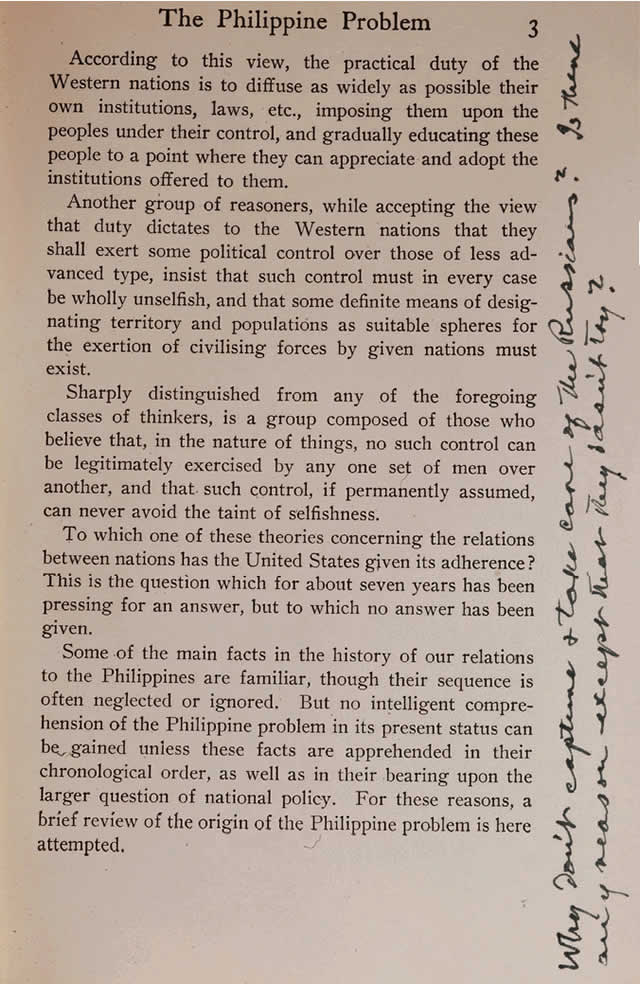
In 1905 Henry Parker Willis published Our Philippine Problem: A Study of American Colonial Policy and discussed the views of colonialism and the obligations and duties of civilized countries to exert political control over countries in less advances stages of development. Clemens received a copy of the book from Charles Francis Adams. In the margin of page 3 wrote, "Why don't [they] capture & take care of the Russians? Is there any reason except that they dasn't try?"
Clemens's copy of Our Philippine Problem where he wrote his thoughts on taking care of the Russians._____
THE "A CLUB" - 1906
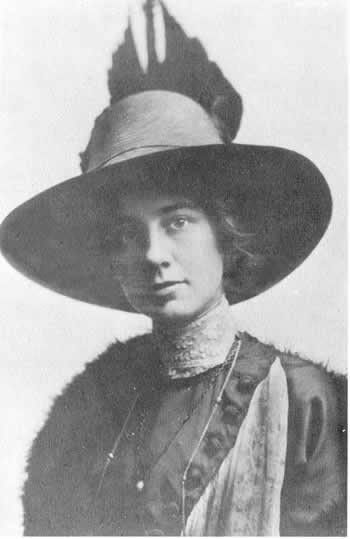
Samuel Clemens's involvement in what eventually became the Maxim Gorky public calamity began on March 27, 1906 when Charlotte Teller came knocking on his front door. Clemens was residing at 21 Fifth Avenue in New York, only a few hundred yards from Washington Square. His house was on the corner of Fifth Avenue and Ninth Street. Teller, the niece of United States Senator from Colorado Henry Moore Teller and daughter of Colorado attorney James Harvey Teller, was an attractive thirty-year-old writer who lived at 3 Fifth Avenue, about a block away.
Charlotte Teller,
Clemens's neighbor on Fifth Avenue.
Photo courtesy of Southern Historical Collection, Wilson Library, The University of North Carolina at Chapel Hill.
The old mansion at 3 Fifth Avenue where Teller lived housed a group of writers that newspapers had tagged the "A Club." The label was based on a quip writer Howard Brubaker had given when a reporter once asked him for the name of the group. Brubaker had replied, "Oh, just call it a club" (30). Residents of the house shared in its operating expenses. A dining room was located in the basement, a music room on the first floor, a writing area on the second floor, and on the top two floors were living quarters (31).
Most of the writers were active members of the socialist movement in the United States. Author Ernest Poole provides one of the best descriptions of life inside 3 Fifth Avenue:
We were known as the A Club. Brubaker, Walter Weyl and I, Leroy Scott and Miriam his wife, Mary Heaton and Burt Vorse [Albert White Vorse], Bob and Martha Bruere, Charlotte Teller and several others were there. With most of us writing books, stories or plays, and all of us dreaming of reforms and revolutions of divers kinds, life in that house was a quick succession of intensities, large and small, from tremendous discussions about the world to hot little personal feuds and disputes; but through it all ran a broad fresh river of genial humor and relish in life. On warm spring evenings some of us sat out on the stoop on Fifth Avenue, sipping mint juleps brought from the old Brevoort Cafe… Charlotte Teller was a good friend of Mark Twain and, from his house around the corner, often he's stroll over, in his white suit with his great shock of snowy hair, sit down by the fireplace, light a cigar and drawl stories to our admiring group. Why did we admire him? Because beneath his good-humored jibes at all radical theories and creeds we could feel him a rebel like ourselves, and because he was a giant, and because he could tell stories as we'd never heard them told before (32).
Teller later recalled her first encounter with Mark Twain:
…word came to a group of us who were living at 3 Fifth Ave, all of us writers, that Tschaikowsky was coming with Gorki to raise money in the U. S. When he arrived I saw him, and found him much depressed because he did not know how to reach Mark Twain, whom he wanted as chairman for a big mass meeting. Although I did not know Mark Twain myself, I offered to see what could be done. I went to 21 Fifth Ave. and asked for Mr. Clemens's secretary. She said to bring Tschaikowsky back at 2 o'clock in the afternoon. I did, and introduced the two men, both of them white haired and most distinguished in appearance (33).
Teller, who was once married to Washington, D.C. civil engineer, Frank Minitree Johnson, introduced herself to Clemens and his secretary Isabel Lyon as Mrs. Johnson. Isabel Lyon recorded in her personal journal
A young and delightfulish Mrs. Johnson came in yesterday to ask if Mr. Clemens would care to meet Mr. Tschaykoffski, the Russian Revolutionary agitator. He came and Mr. Clemens had a good talk with him, but discouraged him a bit I fear. Mrs. Johnson herself is a clever creature, I believe, for she attracts you and she told me how for a year she has been working on a Joan of Arc play for Maude Adams (34).
_____
MEETING NIKOLAI TCHAYKOVSKY
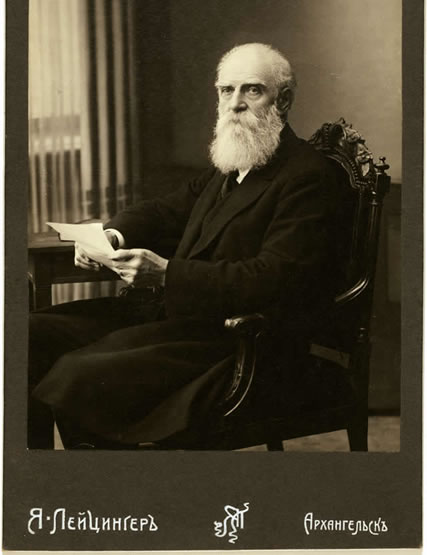
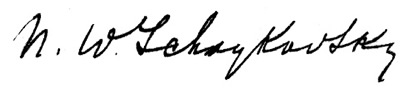
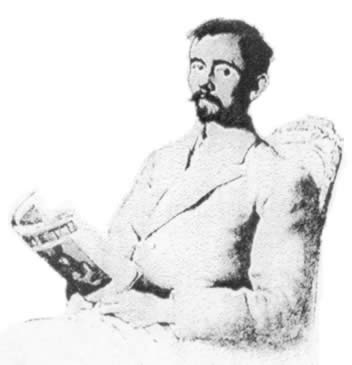
Nikolai Tchaykovsky whose name has been variously spelled Nicholas Tchaikovsky, Tschaikovsky, Chaykovsky, Chaikovsky, Schaykovsky and Tschaykoffski in news reports, letters and private journals will be spelled "Tchaykovsky" throughout this document (unless the reference is in a direct quotation) in order to conform to the way he spelled his own name.
Nikolai Tchaykovsky.
Photo from Library of Congress Prints and Photographs Division.
Signature from letters in Mark Twain Papers, University of California at Berkeley.
Tchaykovsky, born in St. Petersburg about 1842 into a well-to-do family, was educated to be a teacher and taught school for a number of years in Russia. In the early 1870s he became involved in the Russian revolutionary movement and was sentenced to exile in Siberia in 1875. Prior to his exile he escaped Russia and made his way to London. He came to America about 1878 and helped organized a small Russian Socialistic colony near Cedar Vale, Kansas. He later returned moved to Philadelphia where he worked in the shipyards. From there he moved to Mount Morris, New York with a Shaker colony and then returned to Europe. Living in Harrow near London with a wife and three children, Tchaykovsky supported himself by teaching (35).
Tchaykovsky had come to the United States in 1906 to conduct a fund raising effort for arms to equip Russian revolutionaries seeking to overturn the Czar. Tchaykovsky was also laying the groundwork for the April 1906 arrival in the United States of Maxim Gorky. Gorky, the pen name of Alexai Maximovich Peshkov, born in 1868, represented a younger generation of Russian revolutionaries. His pen name, when translated into English meant "Bitter One." Americans had become familiar with Gorky's writings and his news reports which depicted Russian suffering on "Bloody Sunday" 1905. Between January 1901 and March 1906, The New York Times had printed over 200 stories related to Maxim Gorky. After being arrested for anti-Czarist writings after the 1905 revolt many American journals including Scribner's, Century, and Harper's had protested the reports that Gorky would be hung and they joined an outcry for his release from prison. Gorky escaped execution in Russia but he was told to leave the country. Before leaving Russia he contacted American journalist William English Walling who provided him with letters of introduction to his friends at the "A Club."
In early February 1906 the volcano Mt. Vesuvius in Naples, Italy began erupting and throughout the following weeks Clemens's writings and dictation made comparisons to what was happening around him to the Vesuvius eruption. Three days after meeting with Tchaykovsky, he dictated for his autobiography the following passage on March 30, 1906:
Three days ago a neighbor brought the celebrated Russian revolutionist, Tchaykoffsky, to call upon me. He is grizzled, and shows age -- as to exteriors -- but he has a Vesuvius, inside, which is a strong and active volcano yet. He is so full of belief in the ultimate and almost immediate triumph of the revolution and the destruction of the fiendish autocracy, that he almost made me believe and hope with him. He has come over here expecting to arouse a conflagration of noble sympathy in our vast nation of eighty millions of happy and enthusiastic freemen. But honesty obliged me to pour some cold water down his crater. I told him what I believed to be true: that the McKinleys and the Roosevelts and the multimillionaire disciples of Jay Gould -- that man who in his brief life rotted the commercial morals of this natin and left them stinking when he died -- have quite completely transformed our people from a nation with pretty high and respectable ideals to just the oppostie of that; that our people have no ideals now that are worthy of consideration; that our Christianity which we have always been so proud of -- not to say so vain of -- is now nothing but a shell, a sham, a hypocrisy; that we have lost our ancient sympathy with oppressed peoples struggling for life and liberty; that when we are not coldly indifferent to such things we sneer at them, and that the sneer is about the only expression the newspapers and the nation deal in with regard to such things; that his mass meetings would not be attended by people entitled to call themselves representative Americans, even if they may call themselves Americans at all; that his audiences will be composed of foreigners who have suffered so recently that they have not yet had time to become Americanized and their hearts turned to stone in their breasts; that these audiences will be drawn from the ranks of the poor, not those of the rich; that they will give and give freely, but they will give from their poverty and the money result will not be large. I said that when our windy and flamboyant President conceived the idea, a year ago, of advertising himself to the world as the new Angel of Peace, and set himself the task of bringing about the peace between Russia and Japan and had the misfortune to accomplish his misbegotten purpose, no one in all this nation except Doctor Seaman and myself uttered a public protest against this folly of follies. That at that time I believed that that fatal peace had postponed the Russian nation's imminent liberation from its age-long chains indefinitely -- probably for centuries; that I believed at that time that Roosevelt had given the Russian revolution its death-blow, and that I am of that opinion yet.
I will mention here, in parenthesis, that I came across Doctor Seaman last night for the first time in my life, and found that his opinion also remains to-day as he expressed it at the time that that infamous peace was consummated.
Tchaykoffsky said that my talk depressed him profoundly, and that he hoped I was wrong.
I said I hoped the same.
He said, "Why, from this very nation of yours came a mighty contribution only two or three months ago, and it made us all glad in Russia. You raised two millions of dollars in a breath -- in a moment, as it were -- and sent that contribution, that most noble and generous contribution, to suffering Russia. Does not that modify your opinion?"
"No," I said, "it doesn't. That money came not from Americans, it came from Jews; much of it from rich Jews, but the most of it from Russian and Polish Jews on the East Side -- that is to say, it came from the very poor. The Jew has always been benevolent. Suffering can always move a Jew's heart and tax his pocket to the limit. He will be at your mass meetings. But if you find any Americans there put them in a glass case and exhibit them. It will be worthy fifty cents a head to go and look at that show and try to believe in it."
He asked me to come to last night's meeting and speak, but I had another engagement and could not do it. Then he asked me to write a line or two which could be read at the meeting, and I did that cheerfully (36).
Clemens inserted into his autobiography a clipping of The New York Times news story for March 30, 1906 containing the text of his letter that he gave Tchaykovsky to read:
DEAR MR. TCHAYKOFFSKY:
I thank you for the honor of the invitation, but I am not able to accept it because Thursday evening I shall be presiding at a meeting whose object is to find remunerative work for certain classes of our blind who would gladly support themselves if they had the opportunity.
My sympathies are with the Russian revolution, of course. It goes without saying. I hope it will succeed, and now that I have talked with you I take heart to believe it will. Government by falsified promises, by lies, by treachery, and by the butcher knife, for the aggrandizement of a single family of drones and its idle and vicious kin has been borne quite long enough in Russia, I should think. And it is to be hoped that the roused nation, now rising in its strength, will presently put an end to it and set up the republic in its place. Some of us, even the white-headed, may live to see the blessed day when czars and grand dukes will be as scarce there as I trust they are in heaven.
Most sincerely yours,
MARK TWAIN (37)._____
AN INVITATION FROM IVAN NARODNY
Throughout April 1906 the New York newspapers continued to report on the volcanic eruption of Vesuvius as well as incoming Russian revolutionaries. On April 7, The New York Times published an interview with Ivan Narodny. The Times described Narodny as a "chief agent" of the Russian revolution; thirty-six years old; having a half dozen aliases; and the leader of a mutiny among the military in Cronstadt, Russia in October 1905. Narodny told the interviewer how Cossack soldiers had killed his wife and children and burned his home. Narodny was a man with a Czar's bounty on his head. In a lengthy interview Narodny spelled out the disappointments of the Russian people with reforms that had been promised after the Treaty of Portsmouth but never materialized. Narodny emphasized the need for American funds to purchase arms and ammunition for the revolutionary army they were building (38).
Ivan Narodny from The Saturday Evening Post, April 7, 1906.
Also appearing on April 7, 1906 was a lengthy story in The Saturday Evening Post by Ernest Poole which featured an interview with Narodny titled "Till Russia Shall Be Free." Poole's feature told of Narodny's daring deeds; time spent in prison for revolutionary activities; and a variety of disguises, aliases and escapes that had brought Narodny to America in search of funding for a Russian revolution.
Later reports from files in the Bureau of Investigation indicate Narodny's previous name was Jaan Sibul (translated to English as John Onion) who had served time in prison in Estonia in 1898. He had later changed his name to Jaan Tasaneh and left a wife and children in Verro when he came to America (39). The facts of Narodny's life and activities have never been firmly established.
Three days after Narodny's interview appeared in The New York Times and The Saturday Evening Post, he sent a letter to Clemens inviting him to "give us the pleasure of your company at dinner Wednesday evening, April 11th, at seven o'clock, to meet Maxim Gorky" (40).
_____
MAXIM GORKY ARRIVES IN AMERICA
Clemens had dinner with Charlotte Teller the night before Gorky's arrival at 3 Fifth Avenue. Clemens's secretary Isabel Lyon recorded in her diary the following morning on April 11:
Last night Mr. Clemens dined with Mrs. Johnson and her revolutionary tribe -- Narodny and others. No -- Narodny wasn't there either -- but he's to be there tonight, and Gorky too. A buck dinner (41).
What was discussed between Teller and Clemens the evening before Gorky's arrival at 3 Fifth Avenue is not known. However, other residents at the "A Club" had become aware of a pending crisis related to the Gorky visit -- Gorky was bringing with him his common law wife Maria Andreyeva, an actress in the Moscow Art Theatre. (Her name was alternately spelled "Andreiva" in some news reports.) Gorky, in poor political standing with both the church and government in Russia, had never obtained a legal divorce from his first wife. Ivan Narodny had been alerted by Russian banker V. Zaharov that the Czar's agents Ambassador Baron Rosen and Colonel Nikolayev had plans to turn American public against Gorky by giving the American newspapers photos of Gorky's legal wife Katharine Pavlovna Volzhina and two children who were left behind in Russia. If Clemens learned of Gorky's marital situation prior to meeting him and pledging his support, he never indicated advance knowledge (42).
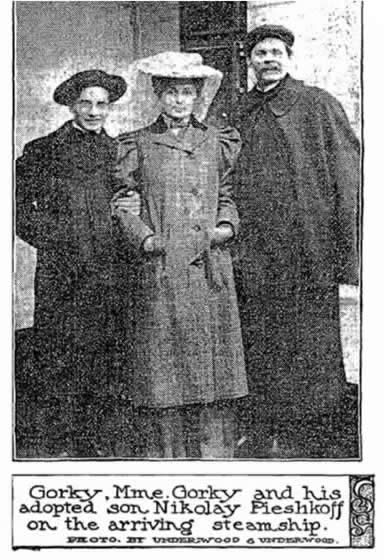
Photo of Gorky upon his arrival in New York
from The New York Times, April 15, 1906, p. SM1.
Gorky arrived in New York on April 10, 1906 and was met aboard the ship by his American host Gaylord Wilshire, editor of Wilshire's Magazine which was advertised as "the Greatest Socialist Magazine in the World" with a circulation of 300,000; Ivan Narodny; Leroy Scott, author the 1905 novel about labor unions titled The Walking Delegate; Abraham Cahan, editor of the Jewish-language socialist daily newspaper Vorwaerts (English translation: Jewish Daily Forward); and several others. The group attempted to persuade Gorky to allow Maria Andreyeva to stay at the Staten Island, New York home of John and Prestonia Mann Martin while Gorky would lodged at 3 Fifth Avenue. John Martin, a native of England and a naturalized American citizen, was a prominent member of the Fabian Socialist society and a member of the executive committee of the American Friends of Russian Freedom. Gorky refused the suggestion. Gorky and Andreyeva were booked into the Hotel Bellclaire at 77th and Broadway in suites reserved for them by Wilshire.
_____
MARK TWAIN AT THE GORKY DINNER
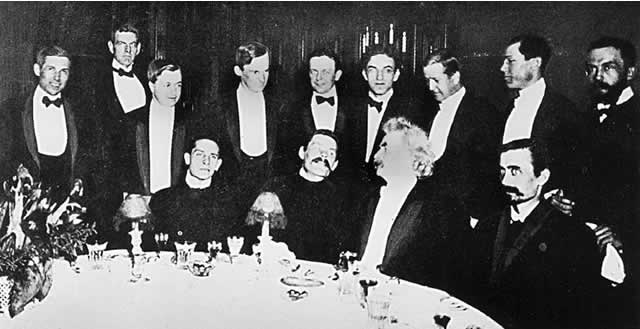
Clemens at the "A Club" house at a dinner for Maxim Gorky.
Front row, L-R: Zinovy Peshkov (Gorky's adopted son and translator), Maxim Gorky, Clemens, and Ivan Narodny.
On Wednesday, April 11, 1906 Clemens attended a dinner at 3 Fifth Avenue in
response to Narodny's invitation. Also present were Nikolai Tchaykovsky; Robert
Collier; Nikolas Burenin, Gorky's friend and private secretary; Arthur Brisbane;
David Graham Phillips; Robert Hunter; Ernest Poole; Dr. Walter Weyl; Leroy M.
Scott; and Howard Brubaker. Zinovy Peshkoff, Gorky's adopted son who was employed
in the offices of Gaylord Wilshire, acted as translator for Gorky who was unable
to speak, read or write English (43). William
Dean Howells and Peter Finley Dunne had been invited but did not attend.
Gorky was extremely delighted to meet Mark Twain. He had earlier told reporters that Mark Twain was well regarded in Russia:
In Russia Mark Twain is almost a cart of everybody's education. There are hundreds of editions of his works in my country (44).
The New York Times, in their story dated April 12, 1906 headlined "Gorky and Twain Plead for Revolution" ran the text of Mark Twain's speech that evening:
"If we can build a Russian republic to give to the persecuted people of the Czar's domain the same measure of freedom that we enjoy, let us go ahead and do it," said Mark Twain. "We need not discuss the method by which that purpose is to be attained. Let us hope that fighting will be postponed or averted for a while, but if it must come -- " Mr. Clemens's hiatus was significant.
"I am most emphatically in sympathy with the movement now on foot in Russia to make that country free," he went on. "I am certain that it will be successful, as it deserves to be. Anybody whose ancestors were in this country when we were trying to free ourselves from oppression must sympathize with those who now are trying to do the same thing in Russia.
"The parallel I have just drawn only goes to show that it makes no difference whether the oppression is bitter or not; men with red, warm blood in their veins will not endure it, but will seek to cast it off. If we keep our hearts in this matter Russia will be free (45).
When Gorky responded to the toasts of the evening through an interpreter he said:
I am so glad to meet Mark Twain, the best known man in Russia. I read his books when I was a mere boy and they have dwelt in my memory. I regard this as a happy day because I have met him. I think a great deal of him. He is a great man always, a man of force, a man who hits hard.
I am sorry that I cannot speak English. I came to America as a stranger and I find deep sympathizers among the Americans for my suffering people who are struggling for their liberty - a liberty such as you now enjoy. Now is the time for revolution. What we want is money, money, money (46).
Robert Hunter explained the purpose of Gorky's visit to American was to ask the American people:
…to aid the Russians in gaining freedom of the press, freedom of speech and of assembly, freedom of ballot, and of conscience. All these things we have in America, and to them we owe our well being, our happiness, our peace, and our prosperity."
Mr. Hunter said after the dinner that the friends of the Russian cause gathered at 3 Fifth Avenue had so far scrupulously refrained from discussing the means by which the purpose of the Russian revolutionists is to be accomplished. They prefer to leave that to the revolutionists themselves. Among the latter there is practical unanimity at this moment that Russia's freedom can be gained only by an armed uprising (47).
On Thursday April 12, Clemens's secretary Isabel Lyon recorded in her journal:
Last night Mr. Clemens dined with Narodny and Maxim Gorky and others down at #3 Fifth Avenue. It must have been a delight even if Gorky cannot speak a word of English. He sat on Mr. Clemens's right and his adopted son acted as interpreter . . ." (48)
Ernest Poole's memoir of the evening at the A Club is one of the best accounts:
Gorki, lean and gigantic, dressed in blue blouse and black trousers tucked into high boots, held all of us spellbound by the stories which in his low deep voice he told through Narodny to old Mark Twain. … Long telegrams from Jane Addams, Howells and other noted people were read. Speeches were made. Reporters arrived, and flashlights were taken of our guests while Arthur Brisbane dictated to a secretary an editorial appeal to be run in Hearst papers all over the country next day. In brief, the evening went off with a bang and when, long after midnight we went out and got morning papers just off the press, in front pages stories in them all we found nothing but promise for Gorki's big tour (49).
Newspaper reports stated that Mark Twain had to leave the dinner early in order to attend another engagement. And in a separate news story The New York Times reported that he attended the international championship billiards tournament in Madison Square Garden with Albert Bigelow Paine during the evening (50).
Gorky also left the dinner at Club A early to attend a dinner that Gaylord Wilshire was hosting for him and for author H. G. Wells who had recently arrived in New York. Other guests at Wilshire's dinner included Edwin Markham, author of The Man With the Hoe; Professor Charles A. Beard and Professor Franklin Giddings of Columbia university; E. J. Ridgway and Ray Brown of Everybody's Magazine; John Corbin; Charles Darnton; W. J. Ghant; Christian Brinton, who published the first English language biography of Gorky; and John Spargo; and Mrs. Castleton. The guests drank Russian tea and smoked Russian cigarettes (51).
One reporter who attended Wilshire's reception for Gorky later wrote his account of the evening:
Men like Tchayhoffsky and Kropotkin, who have worked with pen and voice in this country for their downtrodden brethren in the Empire of the Czar, have impressed us with their earnestness, the serious scholarly temperament that takes a tinge of added somberness, perhaps, from the gray hairs of these students who have thought deeply and thought learnedly of all the abstruse phases of political economy and revolution as these are related to Russia.
Gorky is different. He is young, enthusiastic, emotional. He has the tongue of the poet, the heart of the poet -- a Burns fired with an infinite pity and zeal for the people of whom he is a part (52).
Gorky explained the source of Russian discontent to reporters:
It is the ownership of land about which the great problem in Russia is revolving today….The peasant tills land that is not his own, and furnished wealth to those who do not labor. This oppression is borne by the class composing 72 per cent of the total population, and this vast multitude, awakening from its enforced lethargy, is commencing to demand all arable land for its own. … It is on the education of the peasantry that Russia depends for its freedom. … The Czar, the aristocracy, and the Church hold the arable land, the peasants having only an insignificant portion that they can call their own. What will happen is simply this: the peasantry will demand the land of the Crown and the Church (53).
Gorky's views of the changes that would come about in Russia were similar to those advanced by Henry George in America -- no private ownership of land but a system of advanced socialism and communal land ownership. The attempts of the Russian aristocracy to keep the Russian peasantry uneducated and ignorant may have seemed not unlike the system of black slavery in America to many newspaper readers who considered Gorky's arguments.
Gorky admitted to reporters that his own books were the most widely read of any author in Russia.
It is natural, I think, that the peasants should want to read what I have written. You see, I am a peasant myself. I have been through all that I have described. I have learned of the infamies of an imperial form of government -- the oppression, the injustice -- not from books, but from my own personal experience. They call me the 'Bitter One,' because these experiences whey they are written out do indeed have the savor of bitterness. But they are true -- they could not be otherwise…(54).
When Gorky was asked by reporters again who his favorite American authors were he replied Mark Twain:
I have a special fondness for him of all authors, because I read him at a time in my life when I was beaten for reading. That was when I was what you would call a tramp, just working at any rude job that I could pick up in my wanderings through the towns and villages of my native province. Beatings were liberally dealt out to the peasants in those days -- but I read Mark Twain in spite of them, and I would do it again and count the penalty light enough for the enjoyment that I derived from his delightful books (55).
Gorky also added Walt Whitman and Edgar Allan Poe to his list of American favorites. Professor Charles Beard later recalled that Gorky was vivacious and boylike and enjoyed playing with a couple of rust old firearms Wilshire had displayed in his drawing room (56).
On April 12, 1906 the daily New York World newspaper carried an editorial cartoon of the U. S. Statue of Liberty lighting Gorky's torch.
_____
MARK TWAIN GETS HOWELLS INVOLVED
On April 12 the New York World featured a story on page 4 about Mark Twain at Gorky's dinner at the "A Club" headlined "Dinner to Gorky Marked by Plea For Revolution." Clemens was later photographed in bed holding the newspaper opened to the story.
Photo courtesy of Jim Zwick - www.historyillustrated.com
Clemens later wrote a series of notes to himself when he attempted to recall his thoughts throughout the time period of Gorky's visit to America. He titled the notes "A Cloud-Burst of Calamities." For April 12, he described the day as in bed "harassing" (57). He was no doubt visited by a photographer who took the above photo. Clemens also recalled Norman Hapgood, editor of Collier's Weekly, and Robert Joseph Collier visited to propose a purely "literary" dinner for Gorky. They suggested William Dean Howells and Clemens sign invitations for the dinner.
Maxim Gorky toured New York on April 12, visited the tomb of President Ulysses S. Grant, and signed an exclusive contract to write for William Randolph Hearst's newspaper New York American. Later in the evening Gorky attended a Barnum and Bailey circus with Leroy Scott at Madison Square Garden. Clemens and Howells visited with Gorky about 5 PM on April 12 and were caught by newspaper reporters who wanted interviews as they exited his hotel room.
The following day, April 13, 1906, Howells's and Mark Twain's comments appeared in a New York Times newspaper article headlined "Maxim Gorky Visits the Tomb of Grant":
Mark Twain and W. D. Howells called upon Gorky at his apartments in the Hotel Belleclaire last evening. They remained with him for about half an hour discussing literature, and invited him to attend a literary dinner about a fortnight from now. Gorky accepted the invitation.
Some waiting reporters waylaid Mr. Clemens and Mr. Howells in the hotel lobby after their call. When Mr. Clemens was asked regarding the purpose of their visit he made signals of distress to Mr. Howells, who was some distance away, and said:
"Come here, Howells. You don't look as if you had any information. You are a good man; come back here and tell them all about it, and be sure to make it a private talk so as to get it in the papers."
Mr. Howells modestly averred that the idea of the dinner had originated with Mr. Clemens.
"Yes," said Mark Twain, "we are going to offer Gorky the literary hospitality of the country. He is big enough for the honor. It is going to be a dinner with only authors and literary men present. We want to do it in proper style, and will have authors not only from New York, but from Chicago, and we may have some literary geniuses from Indiana, where I believe they breed 'em" (58).
The New York World reported their version of Mark Twain's remarks in an article headlined "Gorky in Tears at Grant's Tomb":
Mark Twain and William Dean Howells emerged from Maxim Gorky's rooms at the Hotel Belleclaire yesterday afternoon about 6 o'clock. The famous humorist smiled tolerantly as the newspaper men gathered about them in the hotel office, while Mr. Howells edged away as though he hoped to slip out the door unperceived.
"Howells," said Mark Twain, "you don't look as though you had any information, so be a good man and come here a minute."
Mr. Howells returned. Mark Twain assumed a confidential air.
"Now, as I understand it," he said "we are talking privately - so it will get into print. Certain of us are getting up a dinner to be held two weeks hence of purely literary persons in homage to Mr. Gorky and in recognition of his eminent position in the literary world. And by the way, Howells, we forgot to speak to him about it, didn't we? Well, Robert Collier knows more about it than we do - perhaps we're telling his secret."
Just then a guest of the hotel who had recognized the humorist rushed up and shaking Mr. Clemens by the hand said: "I've read all your books from beginning to end."
"Then you have indeed had a liberal education," said Mark Twain, with a twinkling eye.
The humorist-revolutionist denied that he and Mr. Howells had been arranging all the details of the freeing of Russia. "Didn't even speak of it," he declared (59).
On April 13, 1906 a cartoon in the New York World featured Mark Twain dethroning Czar Nicholas II with his pen.
William Dean Howells was less enthusiastic about getting involved in supporting Gorky's plan for Russian revolution than was Clemens. According to Howells:
We were both interested in Gorky, Clemens rather more as a revolutionist and I as a realist, though I too wished the Russian Tsar ill, and the novelist well in his mission to the Russian sympathizers in this republic. But I had lived through the episode of Kossuth's visit to us and his vain endeavor to raise funds for the Hungarian cause in 1851, when we were a younger and nobler nation than now, with hearts if not hands, opener to the "oppressed of Europe"; the oppressed of America, the four or five millions of slaves, we did not count. I did not believe that Gorky could get the money for the cause of freedom in Russia which he had come to get; as I told a valued friend of his and mine, I did not believe he could get twenty-five hundred dollars, and I think now I set the figure too high. I had already refused to sign the sort of general appeal his friends were making to our principles and pockets because I felt it so wholly idle, and when the paper was produced in Gorky's presence and Clemens put his name to it I still refused. The next day Gorky was expelled from his hotel with the woman who was not his wife, but who, I am bound to say, did not look as if she were not, at least to me, who am, however, not versed in those aspects of human nature (60).
_____
FUNDAMENTAL ERRORS THAT LED TO CALAMITY
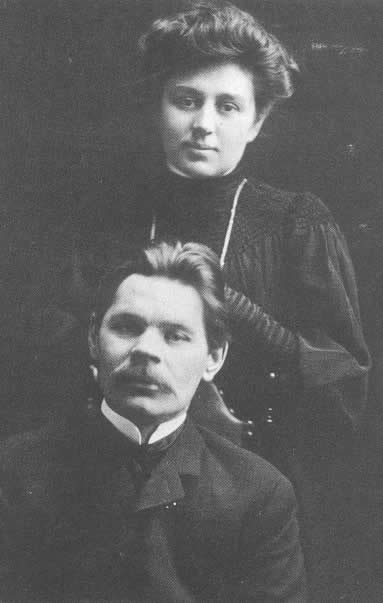
Maxim Gorky and
Maria Andreyeva.
On Friday, April 13 Gaylord Wilshire hosted a reception for Gorky in Gorky's sitting room at the Belleclaire Hotel. Hundreds of well-known society and literary leaders were in attendance including Bliss Carman, Ida Tarbell, Charles C. D. Roberts, Hildegard Hawthorne, Kuechi Kanako, G. M. L. Brown, L. C. Van Noppen, Leonard Abbott, Eugene Wood, Hamilton Nott, G. S. Slosson, and Rev. A. F. Irvine (61). It was in the midst this affair that Wilshire composed a misbegotten telegram which was sent over Gorky's name. The telegram was sent to William D. Haywood and Charles H. Moyer, officers of the Western Federation of Miners, who had been accused as accessories in a December 1905 bombing murder of former governor Frank Steunenberg of Idaho -- the result of previous labor disputes which Stuenenberg had vigorously put down while governor. Gorky, who could neither read or write English, did not fully understand the consequences of meddling in American labor politics.
The following morning, April 14, 1906, the New York World broke the silence surrounding Gorky's marital affairs. The front page of the paper featured a family photo of Gorky and his legal wife and children along with a photo of Maria Andreyeva whom he had brought to America and introduced as his wife.
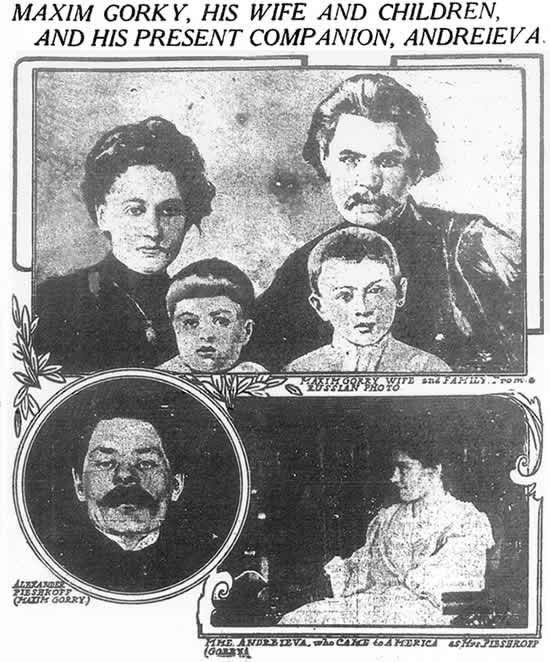
From the front
page of the New York World, April 14, 1906
The World's expose was motivated, in part, by revenge against Gorky who had agreed to write exclusively for publishing rival William Randolph Hearst's newspaper chain. Gorky teaming up with Hearst was a natural progression from his providing Hearst with reports from Russia in 1905. Hearst had recently run for Mayor of New York on a platform favoring municipal ownership of utilities as opposed to private ownership -- both men shared similar socialist philosophies. Not only had Gorky transgressed American customs by traveling with a woman not legally his wife, he had gotten caught in the middle of newspaper rivalries.
To add another calamity to Gorky's plans, on the same day the New York World printed the story about Gorky's marital affairs, The New York Times reported on the telegram signed by Gorky that had been sent to United Mine Workers who were striking in the West. The Times printed the text of the telegram to Haywood and Moyer:
Greetings to you my brother Socialists. Courage! The day of justice and deliverance for the oppressed of all the world is at hand. Ever fraternally yours. MAXIM GORKY (62).
| Although Gorky could not speak nor write English, he had allowed his name to be signed to the telegram sent to Haywood and Moyer that had been composed by Gaylord Wilshire, the American socialist publisher. The message of support to the leaders of one of the most militant labor unions in America was alarming to owners of American industries. | 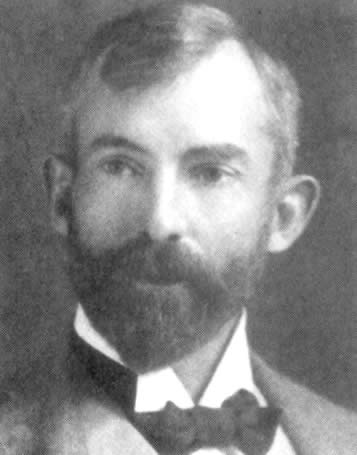 Gaylord Wilshire (1861-1927) He composed the telegram to William D. Haywood and Charles H. Moyer over Gorky's name. |
In American public opinion, Gorky had now become a man with loose morals who was spreading subversion against American capitalism and industry. Upton Sinclair later explained that Gorky had been the victim of infighting between two American groups --"The Friends of Russian Freedom" who were bourgeois and respectable and wanted to confine revolutionary aims strictly to Russia and American Socialists who wished to use Gorky's prestige to further the American cause. Since Gorky supported the accused miners, he would get no money from New York industrialists who might be willing to donate to a Russian revolution but who had little interest in labor reforms for America (63).
_____
MARK TWAIN'S REACTION
Clemens's manuscript "Cloud-Burst of Calamities" indicates he was suffering mood swings between depression and mania during the time of Gorky's visit. When the Gorky scandal broke the following day, Twain described the morning of April 14 in "Cloud-Burst of Calamities":
The pendulum swung the other way -- it was due to swing a day earlier, but it did not do it. I awoke sane at last, & cheerful.
The calamities broke out again but I had had all the damage I could accommodate, & they did not get hold of my heartstrings. The morning papers revealed the Gorky secret. Of course it made a sensation (64).
Biographer Albert Bigelow Paine offers a firsthand glimpse into Clemens's reaction:
Arriving at 21 Fifth Avenue, one afternoon, I met Howells coming out. I thought he had an unhappy, hunted look. I went up to the study, and on opening the door I found the atmosphere semi-opaque with cigar smoke, and Clemens among the drifting blue wreaths and layers, pacing up and down rather fiercely. He turned, inquiringly, as I entered. I had clipped a cartoon from a morning paper, which pictured him as upsetting the Tsar's throne -- the kind of thing he was likely to enjoy. I said:
"Here is something perhaps you may wish to see, Mr. Clemens."
He shook his head violently.
"No, I can't see anything now," and in another moment had disappeared into his own room. Something extraordinary had happened. I wondered if, after all their lifelong friendship, he and Howells had quarreled. I was naturally curious, but it was not a good time to investigate. By and by I went down on the street, where the newsboys were calling extras. When I had bought one, and glanced at the first page, I knew. Gorky had been expelled from his hotel for having brought to America, as his wife, a woman not so recognized by the American laws. Madame Andreieva, a Russian actress, was a leader in the cause of freedom, and by Russian custom her relation with Gorky was recognized and respected; but it was not sufficiently orthodox for American conventions, and it was certainly unfortunate that an apostle of high purpose should come handicapped in that way. Apparently the news had already reached Howells and Clemens, and they had been feverishly discussing what was best to do about the dinner.
Within a day or two Gorky and Madame Andreieva were evicted from a procession of hotels, and of course the papers rang with the head-lines. An army of reporters was chasing Clemens and Howells. The Russian revolution was entirely forgotten in this more lively, more intimate domestic interest. Howells came again, the reporters following and standing guard at the door below (65).
Howells later described his reaction to the Gorky fiasco:
I could remain aloof in my hotel apartment, returning answer to such guardians of the public right to know everything that I had nothing to say of Gorky's domestic affairs; for the public interest had now strayed far from the revolution, and centered entirely upon these. But with Clemens it was different; he lived in a house with a street door kept by a single butler, and he was constantly rung for. I forget how long the siege lasted, but long enough for us to have fun with it. That was the moment of the great Vesuvian eruption, and we figured ourselves in easy reach of a volcano which was every now and then "blowing a cone off," as the telegraphic phrase was. The roof of the great market in Naples had just broken in under its load of ashes and cinders, and crushed hundreds of people; and we asked each other if we were not sorry we had not been there, where the pressure would have been far less terrific than it was with us in Fifth Avenue. The forbidden butler came up with a message that there were some gentlemen below who wanted to see Clemens.
"How many?" he demanded.
"Five," the butler faltered.
"Reporters?"
The butler feigned uncertainty.
"What would you do?" he asked me.
"I wouldn't see them," I said, and then Clemens went directly down to them. How or by what means he appeased their voracity I cannot say, but I fancy it was by the confession of the exact truth, which was harmless enough. They went away joyfully, and he came back in radiant satisfaction with having seen them. Of course he was right and I wrong, and he was right as to the point at issue between Gorky and those who had helplessly treated him with such cruel ignominy. In America it is not the convention for men to live openly in hotels with women who are not their wives. Gorky had violated this convention and he had to pay the penalty; and concerning the destruction of his efficiency as an emissary of the revolution, his blunder was worse than a crime (66).
In "Cloud-Burst of Calamities" Clemens recorded that his secretary Miss Lyon went to bed with a "sore throat" on Saturday, April 14, from talking to so many reporters the day the scandal broke. Clemens also received reports that Robert Collier was unable to fix a date for the Gorky dinner where Howells, Clemens and Collier were all free to attend.
After April 14, the hotel keepers in New York refused to house Gorky and Andreyeva who were ejected from Hotel Belleclaire. They moved to the LaFayette-Breevoort and were ejected from there early in the evening. From there they moved to across the street to the Hotel Rhinelander. After attending a socialist meeting that night, they returned around midnight to find their luggage put out in the lobby. They found shelter after midnight at nearby 3 Fifth Avenue, home to the "A Club."
On April 15, 1906, the Gorky affair was reported in other newspapers across the country along with the stories that they had been evicted from three hotels. The newspaper reporters had gotten their interviews from Clemens and he was widely quoted. The New York Times of April 15 reported:
Mark Twain, one of the members, was questioned on the matter yesterday at his Fifth Avenue home.
"Why," he was asked, "should this country assist in any way the Russian people in their revolutionary movement?"
"Because we were quite willing," he replied, "to accept France's assistance when we were in the throes of our Revolution, and we have always been grateful for that assistance. It is our turn now to pay that debt of gratitude by helping another oppressed people in its struggle for liberty, and we must either do it or confess that our gratitude to France was only eloquent words, with no sincerity back of them."
"But do you think it consistent that Americans, with their so-called love of peace, should aid in a movement to throw Russia into a bloody revolution, particularly in view of the fact that America was chiefly instrumental in bringing to an end the Russo-Japanese war?" To this Mr. Twain replied:
"Inasmuch as we conducted our own Revolution with guns and the sword, our mouths are closed against preaching gentler methods to other oppressed nations. Revolutions are achieved by blood and courage alone. So far as I know there has been but one revolution which was carried to a successful issue without bloodshed."
"In lending, then, our assistance to the Russian people for the overthrow of their despotic form of government, why should we not also start active propaganda seeking the abolition of all similar forms of government?"
"Simply because," replied Mr. Clemens, "we have not been invited to do it. Should the invitation come, as in the present case, we will put our shoulder to the wheel" (67).
In other interviews Clemens seemed to try and distance himself from the Gorky scandal, indicating his association with Gorky's support was merely as a figurehead. He also accused Gorky of transgressing American customs.
The New York Tribune of April 15 quoted Clemens:
I am said to be a revolutionist in my sympathies, by birth, by breeding, and by principle. I am always on the side of the revolutionists, because there never was a revolution unless there were some oppressive and intolerable conditions against which to revolute. …
Every country has its laws of conduct and its customs, and those who visit a country other than their own must expect to conform to the customs of that country. …
Gorky came to this country to lend the influence of his great name -- and it is great in the things he has written -- to the work of raising funds to carry on the revolution in Russia. By these disclosures he is disabled. It is unfortunate. I felt that he would be a prodigious power in helping the movement, but he is in a measure shorn of his strength. Such things as have been published relate to a condition that might be forgivable in Russia, but which offends against the customs in this country. I would not say that his usefulness has been destroyed, but his efficiency as a persuader is certainly impaired (68).
The New York Sun of April 15 quoted Clemens:
I am a revolutionist by birth, breeding, and principle," said Mr. Clemens, "and I am therefore in sympathy with any kind of a revolution anywhere.... There is never a revolution unless there is oppression to instigate the people.... I am one of those impulsive persons who like to be an ornament and figurehead when it comes to matters of public note. I always am willing to lend my name to any organization so long as they don't give me anything to do. That was the way in which I consented to serve on this committee. …
I am in hearty sympathy with the Russian revolutionists, but I fear that Gorky has been ill advised. Whatever may be the way of looking at these things in Russia, we have certain conventions and standards of conduct and Gorky should have been made aware of the views the American people hold in this matter. …
As for the dinner which was to be given to him by the writers and literary people of the country it has been found impossible so far to find a date on which a representative gathering of American authors might be got together to do honor to the Russian. As a literary figure Gorky is certainly deserving of all the honors that can be given him (69).
The New York World quoted Clemens:
"Now I'm a revolutionist," he said, "by birth, breeding, principle, and everything else. I love all revolutions no matter where or when they start.
"I sympathize with these Russian revolutionists, and, in common with some other people, I hope that they will succeed. So when the committee asked me to become a member, I did. I told them, as I am constantly telling other people, that I am always glad to lend my name if they won't give me anything to do. I love to be an ornament and a figurehead. I'd like to be an ornament and a figurehead all over town.
"Well, when Mr. Gorky came here, it seemed to us that he was going to be a prodigious power in getting the American people interested. I don't think it had ever occurred to him that any objection like this would be raised. The people in Russia had always made him feet that his acts were just as they should be.
"But every country has its laws of conduct. It is right that it should, and when anyone arrives from a foreign land he ought to conform to those laws.
"It seems to me that Mr. Gorky has seriously impaired -- I was about to say destroyed -- his efficiency as a persuader. He is disabled, and the propaganda by so much loses the help of his great genius and tremendous personality.
"I don't know what the committee will do. I can tell better after I have had a chance to speak to some of the members. Meanwhile, I believe in sticking by the flag until the last minute" (70).
The New York World reported that Gorky decided to repudiate the telegram which Gaylord Wilshire sent in his name offering sympathy to Haywood and Moyer, the Western Federation of Miners officials who were in prison for the alleged killing of ex-Gov. Steunenberg of Idaho. However, the World did not hesitate to print a reply telegram back to Gorky from Haywood and Moyer who wrote:
Brother: The class struggle, which is world wide, the same in America as in Russia, makes us brothers, indeed. Convey our best wishes to fellow-workers in your native land. We are with you in spirit. Accept the fraternal greetings (71).
Regarding the newspaper interviews Clemens later wrote:
My judgment was against this agitation. I told Tchaikoffsky, that first day, that its chances were very small. I believe it is dead beyond resurrection.
"Are you a socialist?" one of the boys asked.
"No - for it is a party. I have never belonged to a party nor to a church. A person cannot be free & belong to either. The party & the church dictate to him; I would rather do my dictating for myself. By nature & training I am a mugwump."
Have you never done a thing that you bitterly hated yourself for? Did you long for forgiveness? I have [no period] (72)
The last words of Clemens's manuscript "Cloud-Burst of Calamities" are "I have" without a period. If there were additional pages of manuscript they have been lost or destroyed. Clemens's manuscript leaves scholars to ponder the guilt Twain may have felt about not speaking up in Gorky's defense.
Albert Bigelow Paine records his impressions of Clemens the morning of April 15:
It is not quite clear at this time just what word was sent to Gorky but the matter must have been settled that night, for Clemens was in a fine humor next morning. It was before dictation time, and he came drifting into the study and began at once to speak of the dinner and the impossibility of its being given now. Then he said:
"American public opinion is a delicate fabric. It shrivels like the webs of morning at the lightest touch."
Later in the day he made this memorandum: [This memorandum was later used as his conclusion for a manuscript he titled "The Gorky Incident" which was not published until after his death in 1962 in a collection titled Letters from the Earth.]
Laws can be evaded and punishment escaped, but an openly transgressed custom brings sure punishment. The penalty may be unfair, unrighteous, illogical, and a cruelty; no matter, it will be inflicted just the same. Certainly, then, there can be but one wise thing for a visiting stranger to do -- find out what the country's customs are and refrain from offending against them.
The efforts which have been made in Gorky's justification are entitled to all respect because of the magnanimity of the motive back of them, but I think that the ink was wasted. Custom is custom: it is built of brass, boiler-iron, granite; facts, seasonings, arguments have no more effect upon it than the idle winds have upon Gibraltar.
To Dan Beard he said, "Gorky made an awful mistake, Dan. He might as well have come over here in his shirt-tail" (73).
Writing in his memoir "Maxim Gorki in New York," Ernest Poole relates how residents at the "A Club" made arrangements to send Andreyeva to Staten Island to the home of John and Prestonia Mann Martin while Gorky stayed in a spare bedroom at 3 Fifth Avenue. Recalling his conversations with Gorky, Poole writes:
We pleaded with him to help us save for Russian Freedom what we could of his big mission here. For this we still placed hopes in Mark Twain. Howells had already dropped off our committee but, if only old Clemens would remain as chairman and come out strong in a public appeal, we felt that his great reputation might even then turn back the tide. He would think it over, he said, and this he would do only on condition that, in order to keep Gorki from more blunders in talks to the press, for the present we keep his whereabouts an absolute secret. This we agreed to do (74).
Even though the residents at 3 Fifth Avenue kept Gorky from talking to the press as Clemens had advised, reporters continued to knock at the front door of the "A Club." The New York World, Evening edition, April 16, 1906, p. 6 headlined their story "Gorky and His Companion Said to Be at A Club / Fifth Avenue House is a Home for Writers on Socialism." The article explained that Gorky was there as a guest of writer Leroy Scott and that socialist editor Gaylord Wilshire no longer had access to Gorky.
The New York Times of April 16 in a front page article headlined "Out of Third Hotel, Gorky is Now in Hiding" also reported residents at 3 Fifth Avenue denied knowing Gorky's whereabouts even though his fellow revolutionists Tchaykovsky and Narodny were known to be living there.
According to Poole:
How thoroughly we detested our role! We had gladly welcomed Gorki and his wife, yet now we were forced, as though ashamed, to deny is presence with us, not only to reporters but to other friends and visitors, warmly sympathetic to Gorki, who came to offer their aid. I remember the night when H. G. Wells came in and told me: "I've been hunting this whole city to find Maxim Gorki and tell him what I think of this outrage. I have heard that he is with you here." I drew a deep breath and lied once more.
"Sorry. He isn't here," I said. Wells looked at me keenly and perhaps he caught some meaning in the look that I gave him in reply. "We are trying hard," I added, "to keep Mark Twain as chairman of the committee and so save the campaign." …
The very next morning we heard from Mark Twain. He felt that any effort now to go on with our plan was hopeless and therefore he resigned. The big dinner arranged by William Dean Howells and himself was called off (75).
When Clemens's decision was made known to Gorky, he resumed giving press interviews and joined Andreyeva at the Staten Island home of John and Prestonia Mann Martin.
_____
THE PRESS WEIGHS IN
No amount of explanation by Gaylord Wilshire that he had composed the telegram to Haywood and Moyer nor attempts to explain the fact that Gorky was unable to get a divorce in Russia and had parted amicably from his first wife nor a telegram from Gorky's legal wife in support of Gorky could turn around public opinion.
Columnist Burton Beach wrote in the New York Commercial Advertiser: "The whole affair of Gorkyism went smash, as if an American Vesuvius had blown its head off on Manhattan Island. There was fire, smoke, and ashes and lava everywhere, and a universal scattering for shelter" (76).
The Bookman weighed in with a blistering editorial against:
...the amateur anarchists and pink-teak nihilists of American extraction who greeted him with so much maudlin enthusiasm …These foolish individuals think that a revolution in Russia would be a very interesting and laudable affair. It would be so far off as not personally to affect them, and in theory it would be a great and good and glorious event. Their myopic minds cannot realize the appalling horrors which would attend the general uprising of a population that is almost brutish in its incapacity for self-rule. They cannot feel the horrors which would be exhibited in such a hell of blood and lust as would rage in Russia if all restraint were instantly removed. They do not know that the few theorists and intellectuals, who imagine that such an outbreak could be controlled by them, would be swept away like straws before a bursting reservoir. Yet when Gorky openly affronted the social prejudices of America, and also expressed his sympathy with a crime committed in this country, all these nincompoops were shocked to the centres of their little souls. They were willing to applaud rape and rapine when rampant over the whole of a might empire, but the irregular domestic relations of one individual and the violence of a handful of striking miners, when these things occurred upon American soil, seemed to them unsavory and repellent. Their state of mind, after they learned the truth regarding Gorky, would be amusing, were not their purblind inconsistency so contemptible (77).
Harper's Weekly of April 28, 1906 saw the Gorky calamity as "evidence of the irresponsibility which lurks at the bottom of the mind that is capable of accepting the socialistic programme" (78).
Anti-Czarists authors in Russia who had been watching Gorky's American reception expressed their disappointment in a cable sent to the "A Club" soon afterwards:
The American authors represented by Mark Twain have offended Russian authors in the person of Maxim Gorky and Russian womanhood in the person of Mme. Andreieva by interfering with their private affairs. We Russians are amazed at such disregard of the principles of privacy recognized by every civilized country, and hereby express our deep indignation (79).
Ivan Narodny later recalled discussing with Clemens the disappointment Gorky felt when Clemens failed to come to his aid. Narodny quoted Clemens as saying:
"Gracious! What could I do after Gorky failed to listen to your warnings, and did not come to the Club [alone, without Andreyeva]. You know the spirit of our press. My protest would have been published as a letter on the back page, and would have done no good" (80).
Narodny remained at the "A Club" through May and, according to Ernest Poole, made contact with an arms dealer to purchase hand grenades which were stored at the house in boxes marked "soap." Narodny left the "A Club" in June to return to Russia, carrying box after box of "soap" down several flights of stairs (81).
_____
FRANKLIN GIDDINGS ON MOB BEHAVIOR
On April 26, 1906 the journal Independent published an article by Columbia University sociologist Franklin Giddings titled "The Social Lynching of Gorky and Andrieva" comparing their treatment to victims of mob behavior, specifically negroes who had recently been lynched in the state of Missouri.
|
April 26, 1906 THE INDEPENDENT Franklin H. Giddings, Ph.D., LL.D. THE mighty American people, called and set apart by Destiny to be the biggest thing on earth, has made another record. It has had two spasms in one short week. In the State of Missouri it has physically lynched three negroes, accused of rape, but actually innocent. In the city of New York it has morally and socially lynched two distinguished visitors, Maxim Gorky and Madame Andreiva, for unconventional marital relations. In the long annals of man's inhumanity to man there are few chapters likely to be more interesting to the investigator of social psychology than this episode of the moral mobbing of Gorky and Andreiva. In almost every detail it is typical. First came the unsupported accusation of wrong doing. A newspaper story was published, with sensational and question-begging headlines, setting forth that the lady who accompanied Gorky to this country was not his legal wife, altho he introduced her as such, and that he had never been divorced from the first Madame Gorky. This accusation might have been quite true, but no proof was offered. So far as any reader could possibly know, it might be an ordinary newspaper contribution to the history of a never never land. Judgment of condemnation, however, was immediately passed, and the accused was told that it would be impossible for him now to carry out in this country his mission of obtaining sympathy and financial aid for the Russian revolution. Immediately the whole pack of headline melodists took up the cry, and in a few hours a scandalized community had offered up fervent thanks to all the social deities for a timely exposure that had saved decent people from the frightful blunder they were about to commit of inviting disreputable characters to their houses, or meeting them at public receptions. Panic-stricken, the proprietors of hotels, one after another, drove these accused guests into the streets, until, late at night, strangers in a strange land, it had become impossible for them to find any respectable public roof to shelter them, or even to rent an apartment. Their choice lay between a call at the police station, or the private hospitality of pitying friends. In the whole affair, from beginning to end, there was not one interposition of cool reasons of fair play, of giving the accused the benefit of a doubt, of insistence upon suspension of judgment until the case could calmly be looked into upon its merits. All was assertion, accusation, suggestion, innuendo, imitation, hysteria. If, regarded as a psychological phenomenon, there was one essential difference between this eminently respectable mob action in New York City and the conduct of the negro lynchers in Missouri, I hope that some acute observer will discover it. In their lucid intervals. Americans commonly insist that the methods of "La Foule" - the hysterical crowd, the lynching mob -- are unjustifiable, even when directed against persons almost certainly guilty of monstrous crimes. We profess to believe in the excellence of deliberation, and in the principles of civil liberty: We hold that it is better to assume the innocence even of the prisoner at the bar, against whom a formal indictment has been found, until his guilt has been proven beyond a reasonable doubt to the mind of every one of a jury of twelve unprejudiced men. We do not subject him to inquisitorial process. We do not compel him to incriminate himself. We do not even compel him to establish his own innocence. This is our attitude, these are our rules of procedure, when we are entirely sane; that is, when we are not obsessed or "throwing a fit." I use this phrase of Bowery slang because, like many another gem of slang, it is an accurate bit of psychological description. If then, Maxim Gorky and Madame Andreiva had been presumably guilty of even infamous conduct, the treatment to which they were subjected would have been indefensible from the standpoint of sober-minded, reasoning men. What condemnation of it, then, is severe enough, in view of the fact that the conduct for which they were condemned was conduct upon the rightfulness of which enlightened men and women, wholly conscientious and sensitive to points of honor, hold widely differing views. Have we indeed come to this -- that Americans, long accustomed to the gibbering and roasting of negroes without due process of law, are now prepared to settle once for all every doubtful case of morality by the conclusive logic of the mob mind? Maxim Gorky and Madame Andreiva believe that a preference of one chosen man and one chosen woman for each other, and before all others, is the preeminently rightful and decent basis of the marriage relation. They insist that it is not right to set up a technical legal relationship, an economic convenience, or a circumstance of social conventionality as morally superior to the spontaneous preference of a man and woman who know, and whose friends know, that they love each other. In this belief Gorky and Madame Andreiva are not singular. In whole or in part it has been held and taught by some of the best men and women that have yet lived. Dante foretold it in his "Vita Nuova." Petrarch proclaimed it in his fidelity to Laura. John Milton, the sanest, as he was the mightiest prophet of Puritanism, iterated an reiterated it in his famous tract on divorce, which no ecclesiastic with a self-respecting regard for his own intellectual reputation has ever dared try to answer. Shelley and Goethe preached it in both word and deed. Richard Wagner stood for it unflinchingly thruout life, and gave it expression in the imperishable music of "Tristan and Isolde" John Stuart Mill, the calm-minded philosopher, held fast to it thruout his relations with Mrs. Taylor, when his cherished friends cut him because of it; George Eliot proclaimed her own loyalty to it by a life of very quiet but very effective defiance of Mrs. Grundy and all her British matrons, and Herbert Spencer carefully formulated it in his "Autobiography." Perhaps all these eminent persons, being gifted beyond most of their fellow men, were a little bit cracked in the head, and altogether unsafe. That, we know, is the charitable view which is taken by conventional folk that haven't been able to understand or to agree with them. Be that is it may, they all in their day and generation stood for the sort of thing that Gorky and Madame Andreiva stand for today. The Gorky case is in fact essentially like the George Eliot case, as has been shown in the published statement made on Gorky's behalf by Mr. Leroy Scott. Lewes could not get a divorce from the first Mrs. Lewes because British law did not grant divorces in cases such as his. Gorky cannot get a divorce from the first Madame Gorky so long as he remains a Russian subject. In all decency and consistency, therefore, the ladies and gentlemen who have taken part in the social boycotting of the Gorkys should instantly with a long pair of tongs pick up any stray copies of "Adam Bede" or "Romola" that may be lying about their houses, and cast them into the fire, preferably with a pinch of brimstone. Other aspects of this remarkable affair well deserve consideration. One is the cool impertinence with which many local newspapers have presumed to instruct Mr. Gorky in the elements of morality and common sense. Conspicuous among journals that have not descended to such performances has been the sheet that "shines for all," whose discovery that "the purity of our inns was threatened" has been the saving gleam of humor in the situation. Perhaps we should except also, as humorous in quite another way the argumentum ad hominem solemnly delivered by an eminently dignified oracle that entertains conservative views about the humor that is fit to print. It reminded Mr. Gorky that, having come to study a country where public opinion rules, he had been enlightened all of a sudden. Unhappily, this pleasantry may miss its mark, because Mr. Gorky, as an intelligent gentleman of an inquiring turn of mind, if he is too vehemently assured that the phenomena which he has witnessed are ebullitions of public opinion, may hasten away incontinently to discover a land that is ruled by public hysterics. One further phase of the business is more serious, and I wish to speak of it quite seriously. Our newspapers proclaim themselves our trite critics and our rightful sensors, because their word reaches all sorts and conditions of men, as the word of the preacher, of the orator and of the essayist no longer does. They resent the insinuation, when it is made, that their judgments are dictated by the circulation department or the advertising manager. They profess to be guided in all their utterances by stern views of public duty. Very well, let us take them at their word. What, then, are the moral principles that they steer by? In this age of the world they ought not to deal in the occult. Professing to shape public opinion, they ought to give us at least a hint of their rules of procedure. I will be specific. A few years ago there died suddenly in one of the chief cities of America a man of great wealth who controlled vast business interests, and who had been a prominent figure in national politics. Within twenty-four hours every reporter, managing editor and editorial writer on the New York press knew all the circumstances of a taking off that would have made one of the most interesting stories ever committed to print. Not one newspaper in this city told that story. And this act of decent self-restraint was, I suspect, in the minds of right-minded men generally, about the most creditable episode in the history of American journalism. How is it, then, I should like to ask, that these same newspapers find it inconsistent with their public duty to practice a similar restraint when opportunity opens to spare or to assassinate reputations of men and women who do not happen to be powerful, or to be surrounded by powerful friends? Maxim Gorky came to this country not for the purpose of putting himself on exhibition, as many a literary character has done at one time or another, not for the purpose of lining his own pockets with American gold, but for the purpose of obtaining sympathy and financial assistance for a people struggling against terrible odds, as the American people once struggled, for political and individual liberty. Whereupon the American press, which had been so discreetly careful of the reputation of a man whose business associates could have made the newspaper publishing business a precarious means of obtaining a livelihood, deliberately set about to "queer" Mr. Gorky, and to make his mission impossible. The profession of the daily newspaper writer is followed by thousands of high-minded, loyal men. I yield to none in my respect and admiration for them. But when the newspaper press does the sort of thing that it has been guilty of in this Gorky case, it owes an explanation to a public that is not made up exclusively of the unintelligent, and which has, after all is said and done, a sensitive regard for fair play. NEW YORK CITY |
_____
MARK TWAIN'S RESPONSE REGARDING THE FRANKLIN GIDDINGS ARTICLE
Charlotte Teller evidently requested Clemens's opinion of Giddings's article.
In a letter to Teller dated May 4, 1906 Clemens sent his first impression:
Professor Gidding's article is remorselessly severe, but it is all good sense. The editorial is sane, also. The whole case is as pitiful as it can be -- that of those poor Gorkys, I mean (82).
A few days later and after further reflection, Clemens wrote Teller again on May 6 with harsher comments about Giddings and Gorky. His sentiments echoed his first reaction to Gorky's public relations calamity:
I have torn up the preceding sheet: it was mainly about Giddings' article and -- like the article -- not worth while. Giddings did his work well, but what he lacked was a subject; there was nothing before his house; he was establishing the facts of the multiplication table when nobody was doubting those facts; and at the same time he was overlooking the issue that was before the house, and the only one.
In Gorky's case it is a very large one; in Smith's case or Jones's it would have no importance. Gorky is a puzzle and a vexation to me. He came here in a distinctly diplomatic capacity - a function which demands (and necessitates) delicacy, tact, deference, to people's prejudices. He came on a great mission, a majestic mission that of an abused and suffering vast nation. As to his diplomacy, it does not resemble Talleyrand's, Gortschakoff's, Metternich's; it is new, it is original, it has not its like in history; he hits the public in the face with his hat and then holds it out for contributions. It is not ludicrous, it is pitiful. As to his patriotism, his lofty task of lifting up or healing his bleeding Nation - it can't stand the strain of a trifling inconvenience.
He has made a great blunder and persistently refuses to, rectify it.
A diplomat of full age ought surely to know this pair of simple things! that a country's laws are written upon paper, and that its customs are engraved upon brass. One may play with the one, but not with the other. It is less risky for a stranger to dance upon our Constitution in the public square than to affront one of our solidified customs. The one is merely eminently respectable, the other is sacred.
What am I afflicting you with these platitudes for? To get them (and the revolution) out of my system. It looks like using you as a convenience, but I don't see any other way (83).
But Clemens did not get the Russian revolution out of his system. His autobiographical dictation a few weeks later on June 22, 1906 indicates he was agonizing over recent news reports of the massacre of Russian Jews in Bialystok:
For two years now the ultra-Christian Government of Russia had been officially ordering and conducting massacres of its Jewish subjects. These massacres have been so frequent that we have become almost indifferent to them. The accounts of them hardly affect us more than do accounts of corners in a railroad stock in which we have no money invested. We have become so used to their described horrors that we hardly shudder now when we read of them. ... the modern Russian Christian and his Czar have advanced to an extravagance of bloody bestial atrocity undreamed of by their crude brethren of three hundred and thirty-five years ago (84a).
His autobiographical dictation about six months later on December 5, 1906 shows he was still very much an anti-Czarist:
Cruel and pitiful as was life throughout Christendom in the Middle Ages, it was not as cruel, not as pitiful, as is life in Russia today. In Russia, for three centuries, the vast population has been ground under the heels, and for the sole and sordid advantage, of a procession of crowned assassins and robbers who have all deserved the gallows. Russia's hundred and thirty millions of miserable subjects are much worse off today than were the poor of the Middle Ages whom we so pity. We are accustomed now to speak of Russia as medieval and as standing still in the Middle Ages but that is flattery. Russia is way back of the Middle Ages; the Middle Ages are a long way in front of her and she is not likely to catch up with them so long as the Czardom continues to exist (84b).
_____
GORKY'S THOUGHTS ON MARK TWAIN
Gorky continued his campaign in America, crippled though it was. He spoke to audiences, now composed mostly of loyal socialists and journalists, in Boston, Chicago and Philadelphia. Overall, his American endeavor to raise funds for a Russian revolution was a financial failure. In the August 1906 issue of Appleton's Booklover's Magazine he published a condemnation of America titled "City of Mammon" and criticized the "infantile stage of American culture." Gorky left America October 13, 1906 for Italy. Estimates of the amount of money he raised were approximately $10,000 (85).
Regarding Gorky, Clemens later commented to his friend Joseph Twichell, "Poor fellow, he didn't understand our bigotry. Too bad!" Regarding Mark Twain, Gorky's comments to his friends in Russia translated, "He is an excellent man. In this case it occurred that Twain is one of those people who is unclear as to the meaning of facts" (86). Clemens completed an essay titled "The Gorky Incident," which was withheld from publication until 1962 when it appeared in the collection Letters from the Earth. Gorky had never been able to finish a manuscript he titled "M.T." Gorky's manuscript, translated in part by Dan Levin:
The scene: a dinner, where a famous old writer, now a charlatan jokester … and yet … his eyes cunning, but wise … very like an American Luka, in fact … once perhaps a holy wanderer … now a smug trickster … and yet … talks sneeringly about revolution … all very dim … the fragment trails off … Gorky was too hurt to go on, and buried it in his papers (87).
_____
TCHAYKOVSKY CONTINUES THE BATTLE
WITH SPEECHES AND A PETITION
Nikolai Tchaykovsky continued to lecture and give speeches in support of the Russian Socialistic Revolutionary Party. The eloquent elderly spokesperson for the Russian revolution received positive reviews for his appearances. The New York Times of January 5, 1907 reported on an appearance by Tchaykovsky which was attended by 6,000 at the Grand Central Palace the previous evening (88).
In January Tchaykovsky wrote to George Kennan stating:
I have returned here to resume the work which had been interrupted quite unexpectedly by Gorki's misadventure (89).
On February 9, 1907 Tchaykovsky wrote Clemens asking him to preside over a meeting he was planning in Carnegie Hall for welcoming to America Alexis Aladin, the peasant ex-member of the late State Duma. (Aladin's name is alternately spelled Aladyn in various newspaper reports.) Tchaykovsky again wrote Twain on February 19 enclosing a petition he wanted Clemens to sign. The petition would be presented to the U.S. Congress asking for a resolution condemning Russian atrocities (90).
|
We, the undersigned, believe that it is time for civilized nations to protest against the atrocities practiced by the Russian Government in its prolonged warfare against its own people. The subject is one which interests all nations, as a matter of common humanity. On more than one occasion governments have taken action for the amelioration of termination of abhorrent conditions existing in foreign countries. Many instances might be cited, but we content ourselves, as sufficient for our present purposes in citing the case of the Bulgarian atrocities in 1877, when Russia, in taking advantage of the general horror excited by the inhumanities of the Turkish forces within the dominions of the Sultan, intervened in the name of humanity, to rescue the inhabitants of Bulgaria from their deplorable condition. Fifty years before, various European powers, of whom Russia was one, intervened to redeem the Greek inhabitants of the Sultan's dominions from barbarities and oppression. In seeking now some entirely pacific means of inducing the Russian Government to ameliorate the condition of its subjects, we are asking for nothing which the Russian Government has not itself in times past afforded a good precedent. This petition and protest rest solely and entirely upon the instances wherein the Russian Government is disregardful of the usual customs of civilized nations; and wherein it is guilty within its borders of flagrant violation of the terms of agreement of the Geneva Treaty of 1864 and 1868 between the Nations, and also the Second Convention of the Peace Conference at the Hague in 1902. (a) Thousands of men and women are dragged from their homes solely at the discretion or pleasure of local military or police authorities and "administratively" exiled without trial or examination and consigned to inevitable starvation and placed in t he midst of remote settlements of semi-savages (Ostiaks and Yakuts) close to and within the polar circle, where the most loathsome of contagious diseases are chronically epidemic. (See Reports of St. Petersburg "Society Helping Political Prisoners and Exiles" 1906.) (b) Hospitals are deliberately fired upon by regular troops without rebuke. (See Governmental and Duma Committee Reports on Kishenev, Homel, Bialystok and Seidlice Pogroms, See Note I, a, b, and c.) (c) The Red Cross is not respected and the wounded are frequently slaughtered or thrown into the sea or buried alive with the dead. (See above reports on Pogroms; also report on the uprisings at Moscow Dec. 1905, and at Sebastopol and Kronstadt and also Klimkof Report on the Baltiac Provinces. See Note I, a, b, and c.) (d) Women, Children, aged and decrepit men - patently non-combatants, -- are maimed and killed by sword slashings, torn by bayonets, and trampled under hoofs of horses. (See report on Pogroms also report of Klimkof Moscow, 1906, also Official Reports on Events in Koursk, Oct. 1905, See Note II.) (e) Girls and young women inhabitants of districts under military "protection" are repeatedly given over to violation by officers as well as ordinary soldiers. (See Reports on Pogroms by Governmental Commissioners Turau of Kouzminsky, Savich and Duma Committee of Investigation; report of Pietoukhof on Seidlice; also report on the trial of Kishenev; investigation of Society of Caucausian Lawyers on Armenian Massacres - Tiflie and preliminary reports of official commission on the same subject, presided over by Viedenbaum, See Notes II and III.) (f) Hundreds of homes are burned without warrant or reason at the mere whim and will of commanding officers like General Orloff, "the Butcher" and General "Bloody" Alikhanoff. (See Preliminary examination report of the Viedenbaum Commission; the Capt. Pietoukhof on Seidlice. Also Albert Edwards in Collier's Weekly -- Affidavit certifying statements - and Kellogg Durland interview General Alikhanoff in New York Evening Post -- Affidavit certifying statements.) (g) Tortures are applied to prisoners within fortresses and prisons to elicit information. (See Klimkof Report and Official Complaints of Ministers of Justice; reports of Vladimeroff - Sunday World, Jan. 27, 1907 - Affidavit certifying statements.) (h) Field Courts Martial which endeavor to confuse ordinary civil offenses with revolutionary acts leading to the almost daily execution of offenders, who in civilized lands would receive only the most trivial sentences. (See Official Proclamation through Minister of War, 26th of Aug. 1906 and constantly appearing newspaper dispatches - for example "Three persons hanged in public gardens in Odessa for stealing $3.50 etc." Associated Press dispatch, Jan. 1907.) (i) Villages are pillaged and looted by soldiers upon and during military occupancy; and by police and gendarmes during and immediately following disturbances - i. e. pogroms or massacres. (See Governmental and Duma Reports, the Capt. Pietoukhof Report on Seidlice and Note II.) Thus, believing that the present system of restoring order by military and governmental terrorism can produce only a purely artificial and temporary tranquility and can only lead to more widespread disorganization and disorder, we view the present policy of the Russian Government as a menace to the peace of the world, and therefore call upon the Congress of the United States to pass a resolution condemning in the name of humanity the monstrous misuse of military power, which is herein set forth, as the bulwark and support of a government which is opposed by the people. |
On March 4, 1907 the Society of the Friends of Russian Freedom held a meeting
at Carnegie Hall with Tchaykovsky and Alexis Aladin as principal speakers. Aladin's
plea was that the United States not finance loans to the ruling Russian party
that would inevitably be used against the peasants seeking reforms. Clemens
attended the March 4 meeting which was presided over by Dr. Lyman Abbott, editor
of Outlook magazine. Along with Tchaykovsky and Aladin, other prominent
speakers were Felix Adler, William Jay Schieffelin, George Kennan, Senator La
Follette of Wisconsin and Dr. Charles Parkhurst. The New York Times
the following day reported the meeting attracted about 3,000. Members who attended
the meeting endorsed the petition that was presented in Congress by Representative
Bennett of New York which called upon Congress to protest against the perverted
use of the Czar's power (91).
Clemens continued to support the Friends of Russian Freedom but refrained from getting actively involved. On March 20, 1907 he sent the following to Arthur Bullard, Secretary of the Friends of Russian Freedom:
I am in full sympathy with the movement & am willing to have my name used, but as I am too full of duties I cannot furnish any active service (92).
_____
A DETOUR WITH A PRO-CZARIST
COUNT ARTHUR TCHEREP SPIRIDOVITCH
|
Count Arthur Tcherep Spiridovitch.was President of the Slavonic Society of Russia and also of the Latino-Slavic League of Paris and Rome and was an ardent supporter of the Czar Nicholas II. In light of Clemens's longtime anti-Czarist sentiments and continued support of the Friends of Russian Freedom, it was a surprise to members of that organization who read a news story in The New York Times March 28, 1907 reporting Clemens had attended a luncheon at the St. Regis Hotel and made a complimentary speech introducing Spiridovitch. |
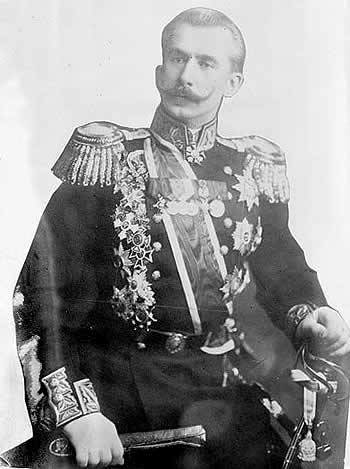 Arthur Tcherep Spiridovitch photo from Library of Congress Prints and Photographs Division |
Entries found in the diary of Clemens's secretary Isabel Lyon indicate that on March 12, 1907 Clemens and Spridovitch likely first met when they shared a box at a benefit performance by Ethel Barrymore in Carrots at the Hudson Theatre. Spiridovitch was also among a group who had dined with Clemens in his home on March 22. Clemens discussed the speech of support incident at length in his autobiographical dictation for March 28, 1907, the same day the New York Times reported he had given a flattering speech for Spridovitch. According to Clemens, a member of the Russian Embassy had approached him during the luncheon for Spiridovitch and asked him to give a speech. "Some occult instinct seemed to inform me that I was in an embarrassing position, and so I thought it best to secure a moment or two in which to collect my judgment and determine what to do." Clemens scrambled around, unable to get anyone else to take the assignment. In consultation with some of the ladies there about his predictament, they suggested he compliment Spiridovitch on the "sumptuous luncheon" on behalf of the ladies in attendance and he agreed (93a). No text of Clemens's impromptu speech introducing Spiridovitch has been found.
Spiridovitch, who was attempting to counteract the publicity and support being generated by the appearances of Tchaykovsky and Aladin, replied to Clemens's humorous introduction with a prepared statement that Clemens described as "out of harmony with the light stuff which I had been delivering" (93b):
While I, as a soldier, would willingly die for the Czar, the liberal-minded and brave Emperor prefers that every one of his people should live for the progress of not only Russia, but the whole human race. He has already immortalized himself in history first by declaring against wars in the world outside and bringing about the creation of The Hague conference, and in the second place by granting to his people a Constitution regardless of dangers and obstacles.
The Constitution has been definitely introduced, but necessarily half a thousand politically trained men to work in the Parliament cannot be produced in a day. We must wait a generation. Andrew Carnegie, one of your best men, has already materialized the idea of the Czar by building a Temple of Peace in The Hague (93c).
In April Spiridovitch explained his purpose in coming to America in a letter to The New York Times. His mission included meeting with President Roosevelt to present him with an award on behalf of the Slavic societies for his initiative in ending the Russo-Japanese war; studying the peace initiatives of Andrew Carnegie; studying benevolent societies in the United States; and learning how the Constitution of the United States worked (94).
Spiridovitch's campaign of support for the Czar was of interest to groups who wanted to hear "the other side" of the story. Spiridovitch reassured his audiences that the majority of Russians were Monarchists and supporters of the Czar. On April 19 at the annual meeting of the Delta Kappa Epsilon Association of New York Spiridovitch was a featured speaker at the Yale Club. Col. John J. McCook, retiring President of the Association told the group that his brother Gen. Anson G. McCook and he had attended the coronation of Czar Nicholas II. McCook recalled Nicholas II commenting on how similar the two nations were:
Russia and the United States have each enfranchised a race. My illustrious grandfather by a single act changed twenty millions of serfs into subjects; President Lincoln by one stroke of his pen changed every black man into a free man. No other nation has ever done that, and none other ever will (95).
The Spiridovitch news reports grabbed the attention of Nikolai Tchaykovsky who wrote a letter of concern to Clemens dated April 1, 1907:
I was rather surprised upon my return to New York to read in the papers your name in connection with a certain adventurer "Count" and "General" Jcherep-Spiridovitch. His name came to our notice before he appeared in public here and several people asked me if I knew him. At that time I had a very vague notion about him and really knew little about him, but when in Chicago I happened to meet Mr. Charles Crane, who knows him for years as an adventurer, trading on orders of his bogus society. Mr. Crane has been warned by the Russian Ambassador against him and his titles. He is no more "Count" or "General" than I am. Whether he acts in any other capacity for protecting the interest of Nicholas II, I am not sure, but it is known that most of the company surrounding the autocrat are of this character. I thought it my duty to warn you in this matter.
In a second letter to Clemens dated April 11, 1907 Tchaykovsky sent another clipping from The New York Times titled "Spiridovitch's Mission" (The New York Times of April 7, 1907, p. SCN17) which again mentioned Clemens's speech for Spiridovitch. Tchakovsky wrote:
…don't you think that your name has been very improperly and unscrupulously used either by this adventurer himself or by some of his dupes, and I shall not be surprised if he makes still further use of it in the European press unless you put an abrupt and public stop to this proceeding (96).
Clemens's secretary Isabel Lyon wrote an unconcerned note of reply to Tchaykovsky stating that Clemens would take no public notice of Spiridovitch (97).
Two letters from Tcherep-Spiridovitch to Clemens survive in the Mark Twain Papers at the University of California at Berkeley. The first is dated February 7, 1907 and the second is dated March 27, 1907. No letters from Clemens to Spiridovitch are known to survive.
_____
TCHAKOVSKY, PRISONER IN RUSSIA
In August 1907 Nikolai Tchaykovsky returned to Russia through Finland and entered St. Petersburg by disguising himself, shaving his beard and using a false name and passport. His intent was to tour the eastern and northeastern provinces and observe for himself the political situation. He visited old friends among the leaders of the Social Revolutionary and Progressive Parties and brought suspicion upon himself by visiting persons who were under the Czar's surveillance. In November, on the eve of his scheduled return to England, he was arrested and imprisoned in the fortress of St. Peter and St. Paul. Tchaykovsky was charged with sedition, criminal conspiracy and agitation abroad. According to Tchaykovsky his age and "super-politeness" helped save him from cruel treatment by his captors (98).
Word of Tchaykovsky's capture and imprisonment reached America by December 12, 1907. On December 17, The New York Times reported that Catherine Breshkovsky, in her 70s had also been arrested. Breshkovsky, who had been confined to Siberia for over twenty years when she was younger, had later come to America and lectured for several years on behalf of Russian freedoms and had become known as the "Grandmother of the Russian Revolution" (99). Clemens was one of many signers of a petition presented to the Russian ambassador pleading for clemency for the elderly Tchaykovsky and Breshkovsky. Clemens also added his name to a similar petition sent to Russian Premier Stolypin (100).
Tchaykovsky was released from prison on bail of 50,000 rubles in December of 1908 and gave an interview to the Independent which was quoted extensively in New York newspapers (101). As the trial for Tchaykovsky and Breshkovsky approached in December 1909, Clemens signed another petition dated Nov. 24, 1909 and sent to Russian Premier Stolypin:
To His Excellency, M. Stolypin:
Sir: It is rumored that Nicholas Tchaykovsky and Catharine Breshkovsky are to be tried together in secret. Permit us to say that we are relying upon your Excellency's assurance that they will have a fair trial, and we assume that such trial will necessarily be open and public in accordance with the time-honored principles of justice in all nations (102).
On March 10, 1910 The New York Times reported that Tchaykovsky had been acquitted (103). He later returned to England where he died on April 30, 1926 (104).Catherine Breshkovsky was not as fortunate; she was sent back to Siberia where she remained until the Czar's government was overthrown in 1917. She died in Czechoslovakia Sept. 12, 1934 at age 90 (105).
_____
HISTORY MARK TWAIN NEVER LIVED TO SEE
Mark Twain died on April 21, 1910. He supported Friends of Russian Freedom throughout the later years of his life. However, he did not live long enough to see any major political changes in Russia in spite of all of his personal and public writings supporting the cause. His biographer Albert Bigelow Paine believed nothing would have given him greater comfort than to see the downfall of Russian imperialism.
As the Russian revolution came to a head in the winter of 1917, Nicholas II was forced to abdicate his throne. He and his family were placed under "house arrest" and moved to various locations across Russia. On the night of July 17-18, 1918 in a cellar in a house in Ekaterinburg, a city in the Ural mountain region, with the approval of Communist Bolshevik leader Vladimir Lenin, Czar Nicholas II, his wife, son, four daughters and several personal attendants were killed with guns and bayonets. Twain's unpublished phrase "Knife a Romanoff whereever you find him" rings hauntingly prophetic. As Gorky had earlier told interviewers, Mark Twain was a popular writer in Russia and many of his works had been translated into Russian. If Lenin had ever read Mark Twain's "The Czar's Soliloquy," scholars have not alluded to that fact.
For years, the exact burial location of the slain Romanov family remained a secret. In 1977 Boris Yeltsin, acting in his capacity as a Communist party boss in the former city of Ekaterinburg, ordered the house where the killings had taken place to be bulldozed in the middle of the night. Communist leaders feared the house had become a shrine to those who opposed Communist rule. In 1991, acting in his capacity as Russian President, Boris Yeltsin ordered bodies recovered from a mass grave and extensive DNA testing was used to positively identify the remains of Czar Nicholas II, his wife, and three daughters. The remains of a son and one daughter remained unaccounted for.
Eighty years to the day after the last Czar of Russia was killed, July 18, 1998, Nicholas II and his family were reburied in St. Petersburg. Boris Yeltsin's speech at the funeral was a plea for nonviolent methods of change:
Dear fellow citizens:
It's a historic day for Russia. Eighty years have passed since the slaying of the last Russian emperor and his family. We have long been silent about this monstrous crime We must say the truth: The Yekaterinburg massacre has become one of the most shameful episodes in our history.
By burying the remains of innocent victims, we want to atone for the sins of our ancestors.
Those who committed this crime are as guilty as are those who approved of it for decades. We are all guilty.
It is impossible to lie to ourselves by justifying senseless cruelty on political grounds. The shooting of the Romanov family is a result of an uncompromising split in Russia society into "us" and "them." The results of this split can be seen even now.
The burial of the remains of Yekaterinburg is, first of all, an act of human justice. It's a symbol of unity of the nation, an atonement of common guilt.
We all bear responsibility for the historical memory of the nation. And that's why I could not fail to come here. I must be here as both an individual and the president.
I bow my head before the victims of the merciless slaying.
While building a new Russia, we must rely on its historical experience.
Many glorious pages of Russian history were connected with the Romanovs. But with this name is connected one of the most bitter lessons: Any attempts to change life by violence is condemned to failure.
We must end the century, which has been an age of blood and violence in Russia, with repentance and peace, regardless of political views, ethnic or religious belonging.
This is our historic chance. On the eve of the third millennium, we must do it for the sake of our generation and those to come. Let's remember those innocent victims who have fallen to hatred and violence. May they rest in peace (106).
In the year 2000, the Russian Orthodox Church canonized Nicholas II as a martyr. In August 2007 the Associated Press announced the finding of remains believed to be those of the Czar's missing son and daughter in a burned area in the ground near Yekaterinburg. The finding, if confirmed by DNA testing, would put an end to persistent rumors that members of the Czar's family had somehow survived execution.
_____
A FINAL ANALYSIS
Mark Twain's writings on Russia spanned forty years. Russian despotism was a topic that seemed never far from his mind and often arose in unlikely bursts of writing. In 1867, Czar Alexander II was considered the great emancipator of Russian serfdom -- akin to Abraham Lincoln who freed American slaves with the Emancipation Proclamation. As Russian reforms failed and stories of chained political prisoners being marched to Siberia penetrated into the American news and magazine outlets, Clemens's attitude changed.
In his most recent book The Author-Cat, Forrest Robinson presents a strong argument that racial-slavery guilt was a motivating factor. According to Robinson:
Clemens felt guilty about slavery because it deprived others of what he himself valued above all things, freedom, and because it was his lot in life to have been complicit, though quite against his best human instincts, in the subjection of black people to conditions that he came in time to regard as morally indefensible. To have looked the other way in the face of the iniquity of slavery was the unpardonable sin for which Clemens never forgave himself (107).
I suggest that in his support for the cause of Russian freedom and democracy that Clemens unconsciously felt an opportunity to minimize guilt associated with American slavery by helping other oppressed people achieve their freedom. No doubt pictures of chained Russian peasants brought back memories of chained black slaves he had seen in Hannibal, Missouri. His privately written outburst about "knifing a Romanoff" appears overly violent and reactive unless there is a personal motivating factor to be found. If one subscribes to Robinson's theory of racial-slavery guilt, the need to kill a guilty conscience, this time in the form of a Russian Czar provides the motive.
With the failure of the Gorky campaign in the United States, Clemens writes of bitter self hatred and longing for forgiveness in his manuscript "A Cloud-Burst of Calamities." Professor Franklin Gidding's article comparing Gorky's treatment to the lynching of Negroes in Missouri must have been a stinging reminder of incidents that gave rise to an uneasy conscience. Clemens's mental self defense was to blame Gorky for ignorance of political and social customs -- and quite rightly so. After the Gorky fiasco, Clemens retreated and his participation in causes for Russian freedom were limited and amounted to little more than name signing. One can only speculate about his reaction had he lived to know of the actual murders of the Romanov family.
UPDATE: MAY 2018
It is always a special discovery to be contacted by someone who is related to a person I have previously written about. In this case Michele Bonder, who is the great niece of Zinovy and Yakov Sverdlov, wrote this week with more information on her family. Zinovy met Mark Twain when he accompanied Maxim Gorky to the United States in 1906. His brother Yakov Sverdlov issued the orders to assassinate the Romanoff family during the Russian Revolution in 1918. Michele writes:
|
April 28, 2018 I appreciated reading about the encounter with Maxim Gorky on his tour, his correspondences, interviews, and writings regarding the tumult surrounding this event. I thought I would contribute a very minor point, because I believe Mark Twain would cherish the irony. He never lived to see the overthrow of the Czar. The article ponders whether Lenin would have read Twain's writing. V.I. Lenin was not the one who ordered the execution of the Romanoffs, it was Yakov Sverdlov, the President of the Secretariat of the newly formed U.S.S.R. acting in tandem with Lenin as an adviser. Yakov Sverdlov, was the brother of Gorky's ''adopted son'' Zinovy Peshkoff, who accompanied him on his trip to America. Gorky was extremely close to the Sverdlov family, and adopted Zinovy so he could pursue a higher education, and mentor his aspirations as playwright and author at the time. Peshkoff was inspired by Twain's writing, and so was his brother, the one who dispatched the telegram which sealed the fate of the family. Twain had started losing hope in the success of overthrowing the monarchy in Russia, and was photographed with Gorky, his mistress and adopted son. Little could he imagine how in 11 years, Gorky's affiliation with a revolutionary family contributed in doing what Twain came to believe would take generations or was futile. Zinovy Peshkoff had another brother, who came to America, around 1913. He listed his address as the Bellclaire in NYC, which evicted Maxim Gorky and his scandalous wife. He was far more successful in obtaining funds for the revolution. That man was my grandfather. Take care, |
REFERENCE NOTES:
(1) Innocents Abroad, Mark Twain, chapter 37, (Oxford University Press, 1996).
(1a) The New York Herald letters were reprinted in "O,Shah," in Europe and Elsewhere, edited by Albert Bigelow Paine, (Harper and Brothers, 1923), pp. 66,68.
(2) "The New Dynasty," Mark Twain: Collected Tales, Sketches, Speeches, & Essays 1852-1890, edited by Louis J. Budd, Library of America, 1992), p. 883.
(3) "Twain, Howells, and the Boston Nihilists," Louis J. Budd, New England Quarterly, September, 1959, p. 351 - quoting Free Russia, Sept. 1890). Budd also documents the appearance of a "Nihilist bomb" disguised as a sugar plum that could be served for desert at royal tables as an item that appeared in a play titled Colonel Sellers that was co-written by Twain and William Dean Howells, p. 352.
(4) Report from Paradise, Mark Twain, (Harper and Brothers, 1952), p. 65.
(4a) "The Course of Composition of A Connecticut Yankee: A Reinterpretation," Howard G. Baetzhold, American Literature, Vol. 33, No. 2. (May 1961), pp. 195-214.
(5) Mark Twain: A Biography, Vol. 4, Albert Bigelow Paine, (Harper and Brothers, 1912), pp. 1656-1657.
(5a) Mark Twain's Letters, Vol. 2, edited by Albert Bigelow Paine, (Harper and Brothers, 1917), pp. 519-521.
(7) Mark Twain's Letters, Vol. 2, Albert Bigelow Paine, (Harper and Brothers, 1917), p. 535-538.
(8) Mark Twain, New Anecdotes, Jokes and Stories, edited by Cyril Clemens, (Mark Twain Society, 1929), p. 15.
(9) "Twain, Howells, and the Boston Nihilists," Louis J. Budd, New England Quarterly, September, 1959, p. 355.
(9a) "Letters from a Dog to Another Dog Explaining and Accounting for Man," Mark Twain's Book of Animals, edited by Shelley Fisher Fishkin, (University of California Press, 2010), pp. 105-106.
(10) The list of members of the American Friends of Russian Freedom appears in "The Reception of Russian Revolutionary Leaders in America, 1904-1906," Arthur W. Thompson, American Quarterly, Vol. 18, No. 3, pp. 452-476.
(11) The American Claimant, Mark Twain, (Oxford University Press, 1996), chapter 18.
(12) Quoted in Mark Twain: Social Critic, Philip S. Foner, (International Publishers, 1958), p. 118.
(13) Tom Sawyer Abroad, Mark Twain, (Oxford University Press, 1996), chapter 9.
(14) "Darkest Russia," The New York Times, January 9, 1894, p. 4.
(15) "Mark Twain to Women," The New York Times, Nov. 24, 1900, p. 9.
(16) "Introducing Winston S. Churchill," Mark Twain's Speeches, edited by Paul Fatout, (Univ. of Iowa Press, 1976), p. 368.
(17) "To the Person Sitting in Darkness," Mark Twain: Collected Tales, Sketches, Speeches, & Essays 1891-1910, edited by Louis J. Budd, Library of America, 1992), p. 465.
(18) "The Stupendous Procession," Mark Twain's Fables of Man, edited by John S. Tuckey, (University of California Press, 1972), p. 407.
(19) "The Belated Russian Passport," Twain's World, CD, (Bureau Development, 1993).
(19a) Autobiography with Letters, William Lyon Phelps, (Oxford University Press, 1939), pp. 456-457.
(20) "Civil War Threatened," The New York Times, January 23, 1905, p. 1.
(21)
"The Czar's Soliloquy," Mark Twain: Collected Tales, Sketches,
Speeches, & Essays: 1891-1910, edited by Louis J. Budd, p. 644. This
essay is also online at http://www.hannibal.net/twain/works/czars_soliloquy_1905/
(22) quoted in Mark Twain: Social Critic, Philip S. Foner, (International Publishers, 1958), p. 316.
(23) "Flies and Russians," Mark Twain's Fables of Man, edited by John S. Tuckey, (University of California Press, 1972), p. 423, 424.
(24) Quoted in Mark Twain: Social Critic, Philip S. Foner, (International Publishers, 1958), p. 119.
(24a) Mary Baker Eddy's telegram and Twain's comments are published in chapter 30, No. 44, The Mysterious Stranger, (University of California Press, 1982).
(25) "Russian Liberty Has Had Its Last Chance," Boston Globe, August 30, 1905, p. 4.
(26) Autobiography of Mark Twain, Vol. 1, edited by Harriet Elinor Smith, (University of California Press,1924), p. 462.
(27) Seaman's views were printed in The New York Times on August 31, 1905, p. 3 in an article titled "Thinks Peace a Mistake."
(28) All three versions of Twain's reply to Col. George Harvey are printed in Ordeal of Mark Twain, Van Wyck Brooks, E. P. Dutton & Co., 1920), p. 238.
(29) "Mark Twain, between Puffs, Talks Some," Boston Journal, 6 Nov 1905, p. 4. Reprinted in Mark Twain: The Complete Interviews, ed. by Gary Scharnhorst, (Univ. of Alabama Press, 2006), p. 506.
(30) Inside Greenwich Village, Gerald W. McFarland, University of Massachusetts Press, 2001, p. 120.
(31) Description of the "A Club" house as 3 Fifth Avenue is from "Gorky and His Companion Said to Be at A Club," New York Evening World, April 16, 1906, p. 3.
(32) The Bridge, Ernest Poole, (Macmillan Company, 1940), p. 171-172.
(33) S.L.C. to C.T., (privately printed, 1925), p. 5.
(34) Quoted in email post to Mark Twain Forum, subject "Gorky Photography," Robert Hirst, November 29, 2000. Archived online.
(35) Biographical data on Tchaykovsky is from "Fear Russia's Worst for Tschaikovsky," The New York Times, Dec. 13, 1907, p. 3.
(36) Autobiography of Mark Twain, Vol. 1, edited by Harriet Elinor Smith, et.al, (University of California Press, 2010), pp. 462-463.
(38) Narodny's interview is in "Russian Republic Near, Declares Leader Here," The New York Times, April 7, 1906, p. 1.
(39) Information from Publication M1085, Investigative Case Files of the Bureau of Investigation, 1908-1922, NARA, online at footnote.com, July 2007.
(40) Quoted in email post to Mark Twain Forum, subject "Gorky Photography," Robert Hirst, November 29, 2000. Archived online.
(42) The identify of the Czar's agents is from Maxim Gorky and His Russia, Alexander Kaun, (Benjamin Blom, 1968), p. 583-584 and based on a letter from Narodny to Kaun.
(43) Source for Zenovy Peshkov's (Gorky's adopted son; his name is alternately spelled "Peshkoff") employment is "Maxim Gorky Discovers America," L. Jay Oliva, New York Historical Society Quarterly, p. 48.
(44) "Dinner to Gorky Marked by Plea for Revolution," New York World, April 12, 1906, p. 4.
(45) "Gorky and Twain Plead for Revolution," The New York Times, April 12, 1906, p. 4.
(46) "Dinner to Gorky Marked by Plea for Revolution," New York World, April 12, 1906, p. 4.
(47) "Gorky and Twain Plead for Revolution," The New York Times, April 12, 1906, p. 4
(48) Quoted in email post to Mark Twain Forum, subject "Gorky Photography," Robert Hirst, November 29, 2000. Archived online.
(49) "Maxim Gorki in New York," Ernest Poole, Slavonic and East European Review. American Series, vol. 3, no. 1 (May, 1944), pp. 80-81.
(50) "Hoppe Defeats Cutler; Schaefer Wins Easily," The New York Times, April 12, 1906, p. 7.
(51) The guest list is from "Dinner to Gorky Marked by Plea for Revolution," New York World, April 12, 1906. p. 4.
(52) "Maxim Gorky on the Russian Revolution," The New York Times, April 15, 1906, pp. SM1, 3.
(56) "That Was New York: L'Affaire Gorky," M. R. Werner, New Yorker, April 30, 1949, p. 65.
(57) "A Cloud-Burst of Calamities," Mark Twain's 4-page handwritten manuscript is ©2001 from the Mark Twain Papers at the University of California, Berkeley.
(58) "Maxim Gorky Visits the Tomb of Grant," The New York Times, April 13, 1906, p. 2.
(59) "Gorky in Tears at Grant's Tomb," New York World, April 13, 1906, p. 6.
(60) My Mark Twain, William Dean Howells, (Dover Publications, 1997), pp. 93-94.
(61) Guest list from "Gorky Brings Actress Here as 'Mme. Gorky'," New York World, April 14, 1906, p. 2.
(62) "Russian Secret Agent is Shadowing Gorky," The New York Times, April 14, 1906, p. 2.
(63) Upton Sinclair's explanation appears in Maxim Gorky and His Russia, Alexander Kaun, (Benjamin Blom, 1968), p. 595-597.
(64) "A Cloud-Burst of Calamities," Mark Twain's 4-page handwritten manuscript is ©2001 from the Mark Twain Papers at the University of California, Berkeley.
(65) Mark Twain: A Biography, Albert Bigelow Paine, (Harper and Brothers, 1912), pp. 1283-1284.
(66) My Mark Twain, William Dean Howells, (Dover Edition, 1997), pp. 94-95.
(67) "Mark Twain's Position," The New York Times, April 15, 1906, p. 3.
(68) "Gorky Sent From Hotel," New York Tribune, April 15, 1906, p. 2. Reprinted in Mark Twain: The Complete Interviews, edited by Gary Scharnhorst, (University of Alabama Press, 2006), pp. 542-543.
(69) "Hotels Turn Gorky Away, New York Sun, April 15, 1906, p.1. Reprinted in Mark Twain: The Complete Interviews, edited by Gary Scharnhorst, (University of Alabama Press, 2006), pp. 542-543.
(70) "Gorky Evicted Twice in a Day from Hotels," New York World, April 15, 1906, p. 1.
(71) "Haywood and Moyer Reply to Gorky's Message of Sympathy," New York World, April 15, 1906, p. 2.
(72) "A Cloud-Burst of Calamities," Mark Twain's 4-page handwritten manuscript is ©2001 from the Mark Twain Papers at the University of California, Berkeley.
(73) Mark Twain: A Biography, Albert Bigelow Paine, Harper and Brothers, 1912), 1283-1285.
(74) "Maxim Gorki in New York," Ernest Poole, Slavonic and East European Review, American Series, vol. 3, no. 1 (May, 1944), p. 82.
(76) New York Commercial Advertiser, April 18, 1906. Quoted in The Uncertain Crusade: America and the Russian Revolution of 1905, Arthur William Thompson and Robert A. Hart, (University of Massachusetts Press), 1970, p. 135.
(77) Maxim Gorky and His Russia, Alexander Kaun, (Benjamin Blom, 1968), pp. 589-590.
(78) Harper's Weekly, April 28, 1906. Quoted in "The Reception of Russian Revolutionary Leaders in America, 1904-1906," Arthur W. Thompson, American Quarterly, Vol. 18, No. 3, p. 469.
(79) "That Was New York: L'Affaire Gorky," M. R. Werner, New Yorker, April 30, 1949, pp. 69-70.
(80) Maxim Gorky and His Russia, Alexander Kaun, (Benjamin Blom, 1968), p. 585.
(81) The Bridge, Ernest Poole, (Macmillan Company, 1940), p. 176.
(82) S.L.C. to C.T., (privately printed, 1925), p. 10.
(84a) "Reflections on Religion," The Outrageous Mark Twain, edited by Charles Neider, (Doubleday, 1987), pp. 37-38.
(84b) Mark Twain in Eruption, edited by Bernard DeVoto, (Harper and Brothers, 1940), p. 212-213.
(85) Source for amount of money raised is: "A Mission That Failed; Gor'kij in America," Felia Holtzman, The Slavic and East European Journal, Vol. 6, No. 3, Autumn 1962, p. 233.
(86) Both quotes are in Mark Twain: Social Critic, Philip S. Foner, (International Publishers, 1958), pp. 123-124.
(87) Stormy Petrel: The Life and Work of Maxim Gorky, Dan Levin, (Van Rees Press, 1965), p. 130.
(88) "Speak for Free Russia," The New York Times, January 5, 1907, p. 7.
(89) "The Reception of Russian Revolutionary Leaders in America, 1904-1906, Arthur W. Thompson, American Quarterly, vol. 18, no. 3, Autumn 1966, p. 464.
(90) Both letters and the petition Tchakovsky sent to Mark Twain are in the Mark Twain Papers - indexed under Chaikovsky to SLC, 9 Feb 1907 and Chaikovsky to SLC, 19 Feb 1907.
(91) See: "Say Czar's Doom is Near at Hand," The New York Times, March 4, 1907, p. 6 and "Aladin Appeals to United States," The New York Times, March 5, 1907, p. 1.
(92) Quoted in Mark Twain: Social Critic, Philip S. Foner, (International Publishers, 1958), p. 124.
(93a) Autobiography of Mark Twain, Vol. 3, edited by Benjamin Griffin and Harriet Elinor Smith, (University of California Press, 2015).
(93b) Autobiography of Mark Twain, Vol. 3, edited by Benjamin Griffin and Harriet Elinor Smith, (University of California Press, 2015).
(93c) "Count Spiridovitch Gives a Luncheon," The New York Times, March 28, 1907, p. 9.
(94) "Spiridovitch's Mission," The New York Times, April 9, 1907, p. 8.
(95) "Russian Loyalists Speak for the Czar," The New York Times, April 19, 1907, p. 3.
(96) Both letters from Tchaykovsky and the newspaper clipping are filed in the Mark Twain Papers - indexed under Chaikovsky to SLC, 1 April 1907 and Chaikovsky to SLC, 11 April 1907.
(97) The note in Isabel Lyon's shorthand for SLC to Chaikovsky, 16 April 1907, is in the Mark Twain Papers.
(98) "Tchaykovsky's Tale of His Prison Life, The New York Times, Dec. 30, 1908, p. 7 and "Tschaikovsky in Strict Seclusion," The New York Times, Dec. 17, 1907, p. 4.
(99) "Hope Tchaykovsky Will Be Freed Soon," The New York Times, Jan. 12, 1908, p. 4.
(100) See: "Clemency Asked For Tchaykovsky," The New York Times, December 19, 1907, p. 4 and "Wants Tchaykovsky Free," The New York Times, December 27, 1907, p. 8.
(101) "Tchaykovsky's Tale of His Prison Life," The New York Times, December 30, 1908, p. 7.
(102) "Americans Active for Tchaykovsky," The New York Times, December 2, 1909, p. 6.
(103) "Tchaykovsky's Acquittal," The New York Times, March 10, 1910, p. 8.
(104) Obituary for Tchakovsky appeared in "Nicholas Tchaikovsky," The New York Times, May 1, 1926, p. 17.
(105) "Mme Breshkovsky Dies in Exile at 90," The New York Times, September 13, 1934, p. 23.
(106) "Address by Yeltsin: We Are All Guilty," The New York Times, July 18, 1998, p. A4.
(107) The Author-Cat, Forrest Robinson, (Fordham University Press, 2007), p. 162.
_____